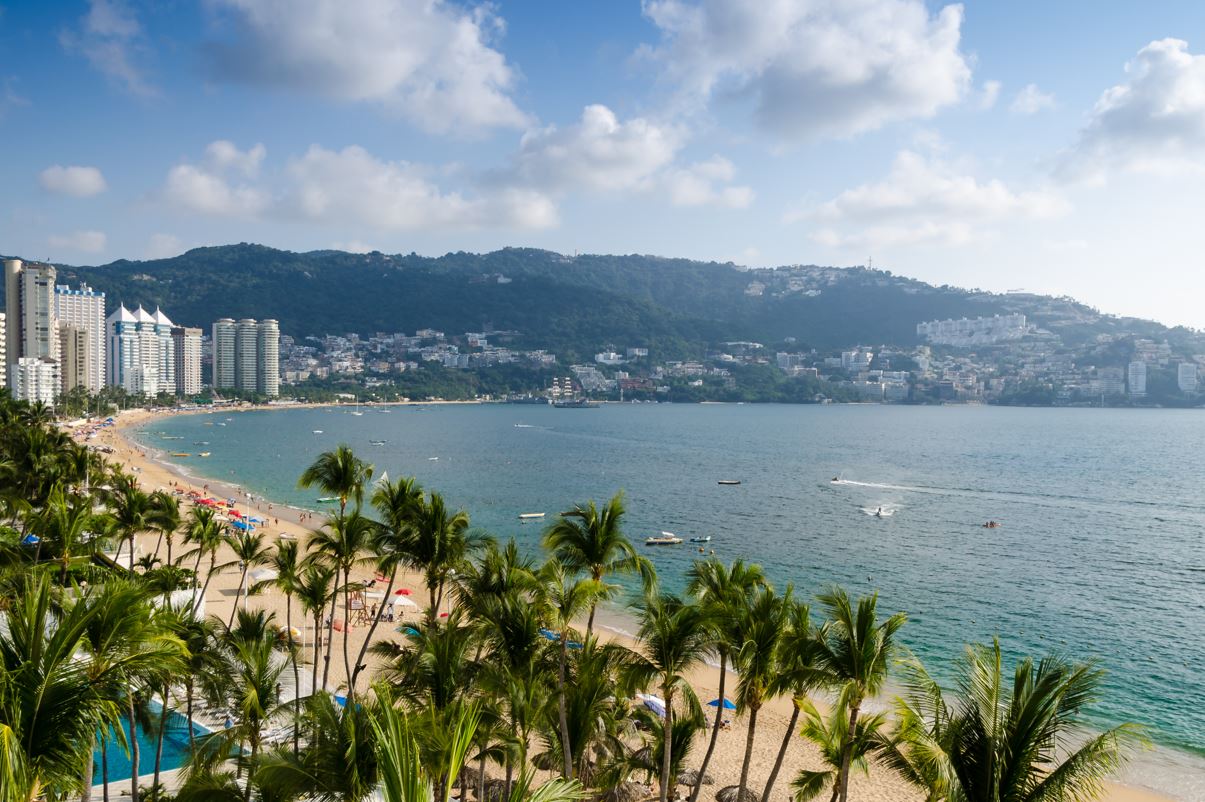
Chiang Mai has been named the safest destination for American travelers in Southeast Asia, beating the far more developed hubs of Singapore and Kuala Lumpur to the number one spot. A culture-filled, sprawling city in Northern Thailand, it is one of the region’s top attractions, known for its imperial grandeur and perfectly-preserved Old City.
Now that Thailand is open once again for tourism, following two years of strict border checks, Americans are returning to the country in droves, drawn to its pristine nature, paradisaical islands, and laid-back atmosphere. Safety remains a top priority for those traveling abroad, though, especially in destinations where they are prone to be scammed.
Scamming and petty crimes are common across a number of Thai cities, but risks seem to be lower in Chiang Mai in particular:
Chiang Mai Is The Highest-Peaking Southeast Asian City On A Safety Perception Index
Every year, the leading crowd-sourced database for quality of life worldwide Numbeo publishes its Crime and Safety Indices by City, with crime rates compiled across 416 cities. According to the ranking, the city of Chiang Mai is one of the top 40 safest in the world, charting at number 32, and the highest-peaking in Southeast Asia (SEA).
Although Singapore is often regarded as the subcontinent’s most developed and ‘Westernized’, and thus less risky city, the overall perception of urban safety is slightly lower than Chiang Mai’s (70.8 against 75.5). It even topples Tokyo, Japan, ranking one slot lower at number 33, and in the wider East Asia it is only surpassed by Hong Kong at number 17.
When it comes to crime, the index averaged 24.5, considered ‘low’: a majority of tourists will feel safe in Chiang Mai, and most will not run into any trouble walking alone in daylight or nighttime. To draw a comparison, Bangkok’s crime index was a much higher 40.5, while safety levels were lower at 59.5 – still high enough to make it the 7th safest destination in SEA.
Three Thai Cities Feature In The Ranking
Anucha Burapachaisri, the Prime Minister’s Deputy Secretary-General for Political Affairs, was quoted saying, ‘Prime Minister Prayut Chan-o-cha is glad to see several cities in Thailand cited as having a high level of safety‘, and that the Government’s determination to eradicate crimes has created confidence among foreigners who want to travel to Thailand.
In total, three Thai cities are cited on the Numbeo list, the third being Pattaya (number 210), sharing the same crime rates as Windsor in Canada. Overall, Thailand is incredibly safe for tourists: the U.S. Department of State considers it a Level 1 destination, advising Americans to exercise ‘normal precautions’ when visiting.
The only regions where travel is strongly advised against are Yala, Pattani, Narathiwat, and Songkhla, due to the ‘ongoing insurgent activities’. These insurgencies are mostly centered in the southernmost provinces of mainland Thailand, where public dissatisfaction with the current government is notably higher.
Thailand’s Incredibly Affordable Cultural Capital
Chiang Mai is one of the most sought-after city breaks in Thailand, and a city brimming with History and imposing structures at every corner. Originally founded in the late 13th century, it replaced neighboring Chiang Rai as the capital of the historical Lanna Kingdom, a position it held until 1558, when its importance as a political center declined.
Still to this day, remnants of the bygone era are scattered around the concrete jungle, with a series of defensive walls and moats, and the Wat Phra Singh and Wat Chedi Luang temples standing among the most easily recognized landmarks. On top of its historical relevance and reinforced security, Chiang Mai is incredibly affordable:
Numbeo estimates that a single person’s monthly costs are US$518.30 without rent, about 25.6% and 10.9% lower than the capital (Bangkok) and Phuket City, two competing hubs within Thailand. Compared to the States, in order to maintain the same standards of living in Chiang Mai as you would earning US$9,000 in New York, US$2,302.70 a month would suffice.
Less crime, a higher quality of life, and significantly cheaper: it’s no wonder Thailand as a whole is the trendiest spot for young adventurers right now.
Have you ever dreamed of ditching the 9 to 5 and taking off to an exotic beach to live in the sun and sand? What if you could do so while saving money on rent and reducing your tax burden? Believe it or not, more Americans than ever are doing just that!
Remote work and digital nomadism are here to stay and only expected to grow. By 2025, 36.2 million Americans are expected to be working from home. About 16% of U.S. companies are already fully remote, and as more workers seek out the flexibility that remote work offers, more companies will have to follow suit to attract top talent.
As a result, jetting off to locations with more favorable living costs and tax laws is becoming an attractive option for Americans who are tired of their dollar not going as far at home.
Inflation hurts less when implementing something called ‘geo-arbitrage’, which basically means earning dollars in a strong economy, and living/spending them somewhere with a lower cost of living.
Paying less for a higher quality of life and lowering your tax burden may seem like a pipe dream, but it doesn’t have to be! There are ways to almost entirely eliminate your tax burden while reaping the benefits of living in an area with a lower cost of living, better weather, and more things to do. In fact, Travel Off Path has interviewed two Americans who are doing just that!
First, Some Tax Background
Before catching up with our interviewees, it’s important to understand the tax benefit being referenced and discussed. All Americans can take advantage of this tax exclusion, called the Foreign Earned Income Exclusion program (FEIE), which is a completely legal and simple way to reduce your taxable income.
Essentially, Americans who meet specific requirements can use this exclusion when filing their taxes to reduce their taxable income by $120,000 (for 2023, the amount is adjusted yearly for inflation). In order to take advantage of this, Americans must meet one of the following requirements:
Be a valid resident of a foreign country for the entire tax year.
Be a national or citizen of a country that has an income tax treaty in effect with the U.S. and who is a resident of a foreign country (or countries) for an entire tax year.
Reside outside of the U.S. and be physically present in another country (or countries) for 330 days out of a calendar year.
While the FEIE can be used in many countries, Latin America is a great place to call home as a digital nomad. Since most nations within Latin America have attractive ‘territorial tax’ laws, meaning there is 0% tax owed when the income is from a foreign source, they make the FEIE program extremely attractive. Combine that with a lower cost of living, vibrant people, and gorgeous destinations. What’s not to love? It’s a popular choice for digital nomads and is also where our first interviewee, Vance, spends the majority of his time.
Vance started the popular podcast My Latin Life, where our CEO Kashlee Kucheran recently spent some time as a guest outlining her path to digital nomadism and running a travel news website. He spends most of his year in Latin America, “bouncing between Mexico, Panama, and Paraguay,” and his reasoning is unsurprising.
“The low cost of living is amazing – earn dollars, spend pesos. I feel more alive in Latin America. Maybe it’s the sun and increased levels of vitamin D. My Spanish is also very good now, and I am happy to have built the lifelong skill of speaking a foreign language. I am very thankful to be able to spend winters on the beach in Mexico instead of commuting to an office in the freezing cold.”
Vance lived in the Northeastern U.S., working in I.T. before learning about becoming a digital nomad and working towards building a skillset that allowed him to take the leap. One of the most influential factors was the tax benefits of becoming a digital nomad.
“I knew I was going to be a digital nomad anyway, but the FEIE really made it a no-brainer. The taxes on $112,000 of income works out to around $17,000 in federal taxes alone. You can really reduce your tax bill to 0% by implementing this one exclusion. It’s like the IRS is telling you they’ll pay you $17,000 a year to stay outside of the United States and travel the world! It can be scary to submit a tax return where you owe $0 in taxes, but it’s more common than you think and totally legit.”
Want To Live This Way Yourself? Earning an Income Online is the Key.
Vance’s story is just one of many. Now more than ever, Americans are flocking to exotic locations to take advantage of the lower cost of living and tax benefits that come with living outside of the United States. However, most people, especially those who’ve always had a more traditional career, wonder how to get started. Dylan Madden, an online marketer and entrepreneur, gives us some really great advice on how to start making an income that can follow you globally.
Firstly, “use your current day job to pay your bills, while you focus on your business during your free time. Don’t just quit your job. Make sure to focus on providing a skill to others who will happily pay you for. Of course, there are many options for earning income online as a digital nomad. However, one of the easiest and longest-lasting methods is freelancing. As there are always people looking to save their time and are willing to pay you if you can do that plus help increase their income.”
Dylan got started doing just this in 2014 when he began to write for various blogs. In 2019, he landed his first email copywriting gig, eventually leading to his current state of running two companies, including his business motivation brand Calm and Collected, and hiring more team members. For those who genuinely want it, digital nomadism is achievable with the right skills, mindset, and dedication.
Why Are Americans Leaving The U.S. To Live And Work Abroad?
In Dylan’s words, “more Americans are choosing to live and work abroad because we’re tired of rising costs of living for not much of a boost in our lifestyle. When we live a much higher quality life abroad for much cheaper.”
To prove his point, he went on to give an eye-opening example. “I have one of the best apartments in Paraguay. It’s only $1,600 a month. If I lived in the USA, the equivalent apartment would cost me upwards of $4k to $6k. Not only that, but a good steak dinner for 2 is only $45. The same meal would cost me easily $100+ in the USA.”
Becoming a digital nomad and moving out of the U.S. has allowed Dylan to live a more stress-free life, retire his mother, give to animal shelters, see 17 different countries, and build up his team so they can also live the life they want.
Where Are The Best Countries To Start Nomading For Americans?
The best places to start your digital nomad journey will depend on your budget, preferred climate, personal interests, and of course, which nations can be tax-friendly. Some of the most loved and popular for entrepreneurial nomads include:
UAE (Dubai)
Mexico
Paraguay
Panama
Colombia
Brazil
Croatia
Albania
Georgia
It’s not hard to see the appeal. As more Americans begin to realize there are more options than sticking it out in a 9-5 for 30 years and then retiring, they will start to take advantage of the many benefits of living and working outside of the U.S.
The above interviewees are only two examples proving the effectiveness of working remotely in another country and taking advantage of completely legitimate tax incentives. There are tens of thousands more. The only question is, are you ready to join them?
It’s true Americans enjoy unrestricted access to most of the world, especially now that Covid curbs are being lifted, but international travel is never entirely hassle-free. In fact, 38 countries continue to require U.S. nationals to pay in order to enter, whether it’s a Visa On Arrival fee, an e-Visa fee, or when issuing an Online Travel Authorization.
The American passport is one of the most powerful in the world, being named the seventh best to hold in 2023, but this does not mean you are eligible to travel abroad by carrying a valid passport only. Numerous other non-health-related rules must be observed, from showing proof of a return ticket to qualifying as a visitor under certain visa restrictions.
In this article, you will know precisely which countries – and territories – have entry fees in place:
What Are The Differences Between VOAs, e-Visas, And ETAs?
First off, we must establish the key differences between Visas On Arrival (VOAs), e-Visas, and Electronic Authorizations:
VOAs
VOAs are required by countries the United States has not signed a visa-waver agreement with but whose immigration laws are still relaxed enough for Americans to travel without applying for a visa at a country’s mission or Consulate in advance. Instead, they can be applied for and issued directly at the border.
e-Visas
Electronic Visas, or e-Visas, on the other hand, are issued online and do not need to be affixed to your passport. It is one of the easiest to obtain, being automatically issued via e-mail upon completion of an online form. Travelers are then advised to have it printed or in PDF form and present it both at the check-in desk and later during border crossing.
Finally, Travel Authorization (or Travel Authority in some regions) applies to U.S. citizens in cases where a visa-free travel accord is in force between the United States and a third state, but pre-registration is still mandatory. They are not considered a visa, though the application process often resembles that of an e-Visa, except it’s usually simpler.
One thing all three have in common? They are (usually) not issued for free and can cost anywhere between USD $7 to $250. Below, you will find the complete list of countries where VOA, e-Visa, and Travel Authorization rules apply, as well as their price*:
**Some prices are expressed in euros (€). Visa rules and fees are extracted both from official Government websites and iVisa, except where noted.
Africa
Africa is the strictest continent of all when it comes to visa rules. In total, only 14 countries offer complete visa-free entry to American tourists, and a further 23 nations either allow applications at the border or enforce an e-Visa regime. Luckily, these are quite easy to obtain, provided you fit the criteria.
In Cape Verde, for instance, travelers are expected to register in advance on the E.A.S.E. platform, as well as pay a processing fee and airport tax (fixed at €59 per applicant as of January 2023). In Egypt, visas can be issued online or at certain points of entry for only $25; additionally, the Seychellois entry permit is free but must be requested once landing in the Seychelles:
VOA – $190 for single-entry (1 month), $245 for multiple entries (3 months)
VOA – $70 for single entry, $90 for multiple entries within a 30-day period
e-Visa – $63.66 for a 90-day permit
VOA – €30 for a 45-day permit
e-Visa, VOA – $25 for a 30-day permit
e-Visa – $52 for 30 days, $72 for 90 days
e-Visa – €85 for single entry (one month), €200 for multiple entries (six months)
e-Visa – $67.6 for a 90-day permit
e-Visa, VOA – $30.58 for single-entry (30 days), $38.23 for multiple entries (60 days), $53.52 for multiple entries (90 days)
e-Visa, VOA – $50 for single entry, $70 for multiple entries within a 30-day period
VOA – $160 for a 3-year multiple-entry visa
VOA – Approximately $50 for a 30-day permit*
*Travelers are advised to contact a Somalian mission in their home country to obtain more information.
VOA – $126.99 for a 30-day permit
VOA – $50 for a single entry, $100 for multiple entries within a 3-month period
VOA – $160 for a 30-day permit
VOA – $40 for a 90-day permit
VOA – $50 for a 90-day permit
e-Visa, VOA – $50 for a 90-day permit
e-Visa, VOA – $30 for single entry, $45 for double entries within a 3-month period
Asia
In Asia, fewer countries maintain border formalities affecting U.S. travelers compared to Africa. Still, the list comprises ten destinations, some of which are incredibly popular among backpackers vacationing in the area – especially when they are young and broke and looking to save money as much as possible when traveling.
After all, dollars stretch the furthest here, helped by weaker currencies and the low cost of living. Despite their huge affordability, Asian countries are infamously known for their hefty entry fees, which may come in the form of visa restrictions or pre-travel registration requirements. Ahead of visiting these spots, Americans must arrange more than a simple passport:
VOA – $50 for a 30-day entry permit (a departure tax of $6 also applies)
e-Visa, VOA – $36 for a 30-day entry permit
e-Visa, VOA – $36.62 for a 30-day entry permit
VOA – $25 for 15 days, $40 for 30 days, $100 for 90 days
ETA – Approximately $10, valid for individual visits of up to 90 days within a two-year period
ETA – $30, issued for up to 30 days
VOA – $30, issued for up to 30 days and renewable for a further 30 once inside the country – available to air arrivals only
Americas & Europe
No countries or territories in the Americas – North, Central, or South – or Europe with whom the U.S. has signed visa-waver agreements with currently require Americans to obtain ETAs and thus pay an entry fee upon landing. In the Americas, the only countries that have imposed visa restrictions on U.S. citizens are Cuba, Venezuela, and Bolivia.
In Europe, a new Entry-Exit System is set to come into force in late 2023, accompanied by their new ETIAS, or Travel Authorization program. Once it’s fully functional, American tourists will be expected to apply for an ETIAS and pay a fee in order to be eligible to enter Europe’s Schengen Zone – much like the Australian, New Zealand, and South Korean models.
Outside Schengen, Americans cannot travel to Belarus and Russia without having obtained a permit. Thus, the only open Eurasian country demanding an entry fee for U.S. passport holders is Turkiye – formerly known as Turkey:
e-Visa – $50, single or multi-entry during a 3-month period, within 180 days
Middle East (Western Asia)
Despite the draconian laws some Governments in the Middle East have enacted over the last few years affecting their own nationals, the region is relatively open for foreigners, allowing them to visit without observing strict dress codes – bar when religion’s concerned – and opening numerous leisure complexes where Western customs are welcomed.
Despite the increasingly liberal policies, some countries have yet to relax their visa requirements or lift entry fees. In Jordan, for instance, a ‘Jordan Pass’ must be issued prior to departure, and while the list of inclusions is extensive, with not only entry fees added to the package but also a number of tourist attractions, the mounting costs can be a deterrent*.
*Especially when flying to these countries from the U.S. is already quite expensive.
e-Visa, VOA – $19, issued for up to 14 days
VOA – $60, issued for up to 30 days
*Visitors can alternatively apply for a Jordan Pass, including entry to over 40 attractions inside the country + the visa fee. Prices range between $98.69 and $112.79.
e-Visa, VOA – $9, issued for up to 3 months
e-Visa, VOA – Multiple entry for $123, with a one-year validity. Visits cannot exceed 90 days at a time.
Oceania
Lastly, there are only 3 nations and territories in Oceania Americans are not permitted to cross the border for free. The most famous examples, Australia and New Zealand require the submission of an online form in advance, known as Travel Authority, which functions like an e-Visa, though issue is almost always automatic once the fee is paid.
In Australia’s case, an ETA is valid for only a year, and U.S. passport holders can freely cross the border for individual visits of up to 90 days at a time within this period, as long as they do not engage in paid activities during their stay. Conversely, the New Zealand ETA (shortened to NZeTA) can be delivered with a two-year duration.
ETA – AUS $10, valid for a year with short-term visits not exceeding 90 days
ETA – NZD $17 through the app, $23 through the official website.
*An additional Visitor Conservation and Tourism Levy (IVL) of $35 is charged.
e-Visa, VOA – $50 issued for up to 30 days
Check Your Visa Requirements Ahead Of Traveling
This is a round-up only, and we are not able to provide more detailed information about Visas On Arrival, e-Visas, Electronic Travel Authorization, and entry fees for specific countries. We suggest you contact the relevant authorities at your destination or a travel agency specializing in non-immigrant visas.
*Countries that impose traditional visa restrictions on U.S. citizens – when visas can only be obtained at a Consulate ahead of travel – are not included here as these are not routinely classed as an entry fee.
*Some entry fees may change from the publishing of this article.
Most of the world already treats Covid as an endemic virus and welcomes unvaccinated travelers in spite of their immunization status. As of now, they can enter over 140 countries completely restriction-free. On the other hand, there are 4 hugely popular destinations yet to lift their health checks fully, and that continue to require tests in lieu of a vaccine pass:
Japan
Having cordoned off its borders for most of the crisis, banning all international travel, we found it hard to believe Japan would reopen for tourism so soon, but it did. Americans – as well as any foreign nationals and non-Japanese residents – are no longer banned from entering the country, but this does not mean all border rules were axed overnight.
Japanese authorities seem to be taking a more cautious approach, and instead of lifting regulations all at once, they have exempted triple-vaccinated passengers only from testing. All other passengers, including those who have received two shots, but not a booster, must undertake a PCR test within 72 hours of their Japan-bound flight.
As further punishment, Americans who do not qualify as fully immunized per Japan’s rules will lose access to ‘Fast Track’, which allows tourists to register their information online for streamlined border control upon landing in Tokyo Narita, Haneda, or any of the main entry points. Instead, their documents will be checked thoroughly by an agent once arriving.
Although this might serve as an impediment to bureaucracy-wary Americans, it has not stopped the demand for travel to Japan from skyrocketing since the reopening announcement. Multiple airlines have since relaunched nonstop flights from North America, and the country was named the sixth trendiest destination in Asia by Kayak.
The largest country by territorial expanse in South America, Brazil boasts a high degree of biodiversity and ethnic diversity like no other. Home to the Amazon jungle, an extensive Atlantic coastline interspersed with resort towns and colonial-era settlements, and of course, world-class cities like Rio and Sao Paulo, it’s easy to see how it’s a bucket list item for many.
Brazil also remained open throughout Covid, maintaining no health screening formalities at the border even after the pandemic was declared and most of Europe, Asia, and North America shut down for tourism. Interestingly, things changed drastically when vaccines became available, and they went from being extremely lax to stubbornly strict.
Unvaccinated U.S. visitors can still enter for non-essential purposes, but they must present a negative Covid test – PCR or Rapid Antigen – taken no more than 24 before boarding an international flight or crossing via land from neighboring countries. Proof of recovery in the last 90 days is accepted, too, though on-arrival testing could be carried out.
Seeing that a number of states in the Brazilian Federation have recently reimposed mask requirements across some settings, it’s hard to predict when it will finally move on from the pandemic.
Colombia
Colombia is yet another sunny spot that has adopted a tougher stance following the development of Covid vaccines. Once one of the ‘freer’ countries to visit, it has now sided with Brazil in imposing tougher controls on unvaccinated Americans, and they are not alone in this: over 75% of South America has not reinstated normal entry guidelines.
Traveling to Colombia, specifically, Americans who have not completed their initial vaccination scheme of two doses, or whose second dose was given less than two weeks prior to travel, or who were not immunized at all, will only be permitted to board their flight showing proof of a negative PCR or Antigen – much like Brazil, except the testing window is wider:
Results issued up to 72 hours prior to embarkation will be accepted, though not older. It is worth noting passengers who have a short layover in Bogota, Medellin, Cartagena, or other major hubs on their way to a destination outside Colombia are not exempt from the rules: they must follow the requirements set out by authorities in order to avoid problems.
Once in Colombia, you may still have to wear face masks in certain environments depending on the mandates in force, which change based on the epidemiological scenario.
Philippines
Famous for a plethora of paradisaical islands, pristine beaches bordering a turquoise-colored ocean, flavorful cuisine, Spanish colonial heritage, and the chaotic conurbation that is Manila, the vibrant capital city, the Philippines appeal to all categories of travelers, from sun-seekers and city slickers to History buffs and off-grid travel enthusiasts.
As long as they are vaccinated and can produce a valid WHO-approved immunization card at the outer border, they will be waved through unceremoniously. Failing to do so, they must have a negative Covid test in their hands, issued up to 24 hours ahead of departure. Normally, airline staff verifies the relevant documentation at the check-in desk.
In the unlikely event you find yourself flying without vaccination proof and without having undergone testing, you will be required to take a test arriving at the airport. Anyone who tests positive for Covid upon arrival could be subject to quarantine and isolation protocols as established by the Department of Health.
At this point, the Filipino Government has not given an indication as to when the remaining border measures, including that of testing applying to non-immunized individuals, will be lifted. The Philippines may be refusing to loosen curbs, but several Southeast Asian (SEA) competitors were not as conservative.
Traveling to these SEA countries below, unvaccinated Americans are not subject to testing or further health-related requirements:
*Entry rules for Thailand are subject to change without warning, as seen last week. Unvaccinated Americans must ensure they are up to date with recent developments in Thailand in order to avoid unpleasant surprises.
If being active on your vacation gives you anxiety, you’re not alone. There’s a more popular type of travel that has Americans adding relaxing locations to their wish lists. Dubbed the “nothing-cation” – also known as a trip where relaxation and warm weather are the main highlights, this type of travel is becoming more popular with travelers, and they aren’t feeling guilty about it.
Expedia recently conducted a survey of travelers and found that more than 34% of Americans are feeling burnt out after all the festivities of the holidays (especially parents), and almost everyone (96%) plans to do absolutely nothing on their next trip.
It’s no surprise that January comes as the top month for booking beach vacations. It’s the middle of winter, and people are sick and tired of cold and rain. What better time to travel? Some also see it as a great way to reduce anxiety and kick-start the new year.
Expedia found that about a quarter of getaways planned in January are to beach destinations, such as Mexico’s Cancun and Riviera Maya, Dominican Republic’s Punta Cana, and Hawaii’s Oahu, which have all doubled in demand compared to the previous year.
“There’s a time and place for an action-packed vacation itinerary, but our data shows the first trip after the hectic holiday season calls for a more relaxed agenda,” says Melanie Fish, head of Expedia Group brands public relations in a press release. “For most travelers, getting the most out of their next vacation means setting aside dedicated time for nothing.”
There’s no need to feel guilty about doing nothing because almost two-thirds of travelers (62%) agree that “doing nothing” is the best part of a vacation and think it is time well-spent. The travel experts at Expedia have put together 7 destinations where you can enjoy a “nothing-cation”.
With more than 60 beaches to explore that offer up activities such as snorkeling, water sports, or just being lazy in the sun, Kauai has remarkable beauty that is considered one of the less-developed areas of the island. When you want to take a break from laying by the pool, there are some beautiful scenic drives or coastline walks that will give you a nature kick and some added relaxation.
Costa Rica
Nestled between the Pacific Ocean and the Caribbean Sea, you’ll find a different vibe depending on where you end up, but its landscape will sway you into relaxation. Costa Rica has been praised for its ecological practices that promote an abundance of biodiversity and wildlife, which keep tourists singing its praises for its crystal-clear waters, luscious national parks, and its well-preserved jungle.
Fiji
Fiji has over 50 resorts to choose from, where you will leave feeling pampered and well-rested, whether it be from the traditional Bobo massages or from the gentle exfoliation of its white sands. From swimming under its picturesque waterfalls to floating in its lagoons and watching the sunset on a cruise, Fiji offers many quiet places to relax and connect with nature.
Nevis, Caribbean
Surrounded by the crystal-clear waters of the Caribbean Sea, this island is considered one of the most unspoiled and relaxing islands in the area. Known for its peaceful pace of life and easy-going attitude, you’ll marvel at the long empty beaches to explore and its luscious mountain views. From spa treatments to fresh local food that will send you into a food coma, the whole experience will feel effortless.
Koh Samui, Thailand
Thailand’s second largest island was once an old fishing community but has turned into a popular resort island, thanks to its palm-fringed gorgeous beaches. The island is known to attract a variety of visitors, from young budget tourists looking to have fun to more luxury travelers wanting to enjoy high-end villas and resorts. Enjoy the serenity in a Buddhist temple or take a stroll through the charming Fisherman’s village.
Algarve, Portugal
Located along the southern coastline of Portugal, the Algarve contains gorgeous sandy beaches, picturesque coves, a calm and warm ocean, thermal springs, and a perfect climate all year round to enjoy a relaxing holiday. Take your pick between the long stretches of sand to explore or the mountain regions where old traditions are still honored.
Sanibel Island, Florida
Known for its pastel-colored seashells and the “Sanibel Stoop” – a posture used to collect seashells, this small island offers family-friendly fun and plenty of relaxation on its pristine beaches. The island offers activities from dolphin-watching on a boat to biking its 25-mile bike paths or touring its 6,000 acres of mangrove jungles and wetlands in the Wildlife Refuge.
There’s no denying we’re in a different stage of the pandemic than we were just a few months ago. As Covid becomes less disruptive, an ever-expanding list of destinations is abandoning their draconian measures once and for all and reinstating normality. In total, 142 countries are welcoming unvaccinated Americans restriction-free moving into 2023.
The road here has not been the easiest: there have been numerous setbacks and conflicting information as national governments scrambled to find their way out of the health crisis without wiping out small businesses heavily reliant on tourism. Luckily, the days of doom and gloom are well behind us, and the future has indeed never looked brighter.
Whether it’s Europe’s medieval walled towns or Asia’s unspoiled nature, the unvaccinated have a myriad of options to pick from:
Unvaxxed Americans Are Welcome In 73% Of the World
According to Kayak, there are 142 countries across 9 different geographical groups open for travel without any health-related entry requirements. Flying to any of these destinations, tourists are not subject to any Covid checks prior to, during, or after arrival: no testing regime applies, quarantine is not mandatory, and most importantly, vaccination is optional.
The same entry guidelines apply to all travelers, irrespective of the point of embarkation or nationality. This includes unvaccinated Americans, who can now access dozens of countries that, early on in the pandemic, had issued an outright ban against them on the basis of their immunization status. Effectively, they are welcome in roughly 73% of the world:
Popular for safari excursions, wildlife sightings, and natural world experiences, the continent of Africa is much more diverse and culturally rich than it gets credit for. It is also surprisingly safe, with 16 African countries ranking among the least-risky globally for tourists, including the sunny spots of Tunisia and Cape Verde:
Algeria
Benin
Botswana
Burundi
Cape Verde
Egypt
Eritrea
Eswatini
Ethiopia
Gabon
Gambia
Madagascar
Mauritius
Morocco
Namibia
Republic of the Congo
Reunion
Rwanda
Senegal
Sierra Leone
South Africa
Tunisia
Asia
Although great strides towards re-establishing freedom of movement have been made in recent months, Asia remains one of the least-tourist-friendly continents, with only 16 countries out of 48 having returned to their 2019 entry guidelines. Fortunately for tourists, all major tourist hotspots, such as Thailand, Malaysia, the Maldives, and Japan have dropped all Covid curbs:
Armenia*
Bhutan
Brunei
Cambodia
Georgia*
India
Kazakhstan
Kyrgyzstan
Malaysia
Maldives
Mongolia
South Korea
Taiwan
Thailand
Uzbekistan
Vietnam
*Armenia and Georgia are variously described as European, Asian, or cross-continental. On Kayak, they are listed as Asian countries.
The Caribbean
The go-to winter destination for Americans flying abroad, the Caribbean continues to experience arecord surge in demand now that most islands have either relaxed entry rules or lifted them altogether. If it’s relaxation you’re after, sipping margaritas with an emerald ocean for a view as the political noise fades in the background, these are your top picks:
Anguilla
Antigua and Barbuda
Aruba
Barbados
British Virgin Islands
Cayman Islands
Cuba
Curacao
Dominica
Dominican Republic
Grenada
Guadeloupe
Jamaica
Martinique
Puerto Rico*
Saint Barthelemy
Saint Kitts and Nevis
Saint Lucia
Saint Vincent and the Grenadines
St Maarten
The Bahamas
Trinidad and Tobago
The U.S. Virgin Islands*
*Flying to Puerto Rico or the U.S. Virgin Islands, Americans are not required to bring a passport as they are domestic destinations part of the U.S.
Central America
From Costa Rica’s tropical jungles to the historic Mayan ruins lining the Belize-Guatemalan border, Central America is highly sought-after for its nature, high affordability, and cultural wealth, especially now that vaccination restrictions no longer apply. Recently, it even surpassed Europe as the number-one destination for solo travelers:
Belize
Costa Rica
El Salvador
Guatemala
Panama
Europe
By far the easiest continent to navigate in the present-day, Europe is completely open for tourism and business as usual. Driving along the coastal route connecting France to Spain, taking a scenic train from Italy into Switzerland, or flying anywhere within the European Zone, unvaccinated Americans have nothing to worry about:
Albania
Austria
Belarus*
Belgium
Bosnia and Herzegovina
Bulgaria
Croatia
Cyprus
Czech Republic
Denmark
Estonia
Faroe Islands
Finland
France
Germany
Gibraltar
Greece
Hungary
Iceland
Ireland
Italy
Jersey
Kosovo
Latvia
Liechtenstein
Lithuania
Luxembourg
Malta
Moldova
Montenegro
Netherlands
North Macedonia
Norway
Poland
Portugal
Romania
Russia*
Serbia
Slovakia
Slovenia
Spain
Sweden
Switzerland
Turkey
United Kingdom
*All travel to Belarus and Russia is currently discouraged due to the latter’s ongoing aggression against neighboring Ukraine.
The Middle East
Traditionally a more conservative region where Covid rules can be infamously strict, the Middle East is currently more accessible than it has been since March 2020, with 10 countries marked as ‘fully open’ on Kayak. One of them, the pro-Western Israel, has been named the best fall & winter travel destination by Travel Off Path this year.
Afghanistan
Bahrain
Israel
Jordan
Kuwait
Lebanon
Oman
Qatar
Saudi Arabia
United Arab Emirates
North America
With the notorious omission of the United States, North America’s restriction-free circle comprises five nations. Out of those, Mexico has been the determined champion of a free world, keeping its borders open throughout the pandemic and removing all Covid-related formalities, which were very few to begin with, as early as January:
Bermuda
Canada
Greenland
Mexico
South America
Believe it or not, a majority in South America continues to openly discriminate against unvaccinated U.S. travelers, expecting them to undergo testing ahead of flying and, in some cases, fill out an entry form that enables contact tracing. All hope is not lost, as the below hubs have long ceased enforcing health mandates at their borders:
Argentina
Ecuador
Falkand Islands
French Guiana
Guyana
Paraguay
Peru
South Pacific
Lastly, 10 out of 15 sovereign states in the South Pacific region have scrapped mandatory vaccination, testing, and self-isolation practices, accepting all visitors under the same set of pre-Covid rules. We’re not sure about you, but Australia’s golden sand beaches or those recluse Polynesian all-inclusive resorts have never looked as appealing as they do now:
American Samoa
Australia
Cook Islands
French Polynesia
Guam
New Caledonia
New Zealand
Papua New Guinea
Samoa
Vanuatu
It is worth noting there are many more countries unvaccinated Americans can enter by presenting a negative pre-departure test, such as Brazil and Colombia, or an accepted proof of recovery. In this article, however, we have included only countries and territories where no health-related requirements apply and where tourism is subsequently hassle-free.
In order to keep up with all the latest border reopenings and other news affecting American travelers, please visit this link.
Now that their borders have reopened and they seem to have moved on from the darker days of the pandemic, Thailand is once again smashing tourism records and strengthening links with North America. In fact, new research has confirmed it is the go-to destination for U.S. citizens in Southeast Asia – but what’s behind this new wave of popularity?
For most of 2020 and 2022, Southeast Asia (which we’ll shorten to SEA) remained virtually sealed off for tourism as local governments cracked down hard on Covid, banning most, if not all, foreign arrivals, and imposing controversial measures such as nightly curfews and lockdowns. Thailand was no exception.
Certainly, we did not expect Thailand to bounce back as strongly or this quickly, yet here we are:
A Budget-Friendly Paradisaical Escape
As verified in new research conducted by BBC News, Thailand is the number one pick for both Americans (including Canadians) and Europeans when planning a trip to Southeast Asia. As a matter of fact, more than half of all respondents cited Thailand as their preferred destination over Cambodia, Vietnam, the Philippines, and other competitors.
To be more precise, 57.4% of those surveyed stated they would more likely visit Thailand than any other country in SEA. Why, then, is Thailand so trendy right now? In other words, why are thousands of Americans flying to the other side of the world, and facing long layovers in foreign airports, when there are other easier-to-reach sunny spots closer to home?
We have two possible answers: first, there is budget, and second, Thailand’s stunning nature and the fact that it is simply the perfect destination for culture-driven explorers. We will begin with budget, a pressing concern for many U.S. citizens going abroad amid the ongoing economic upheaval and the soaring costs of travel fueled by inflation.
Thailand Is Much Cheaper Than Other Sunny Spots In The Western Hemisphere
Luxury travel is on the rise worldwide, as tourism boards around the globe begin focusing more on big spenders and long-term vacationers in hopes of cashing in from their willingness to pay more, no matter how much, for high-quality services. This includes semi-private jets, five-star, all-inclusive resorts, and other unique experiences.
Not all travelers are keen on the splurging trend, though: many of them are actively seeking cheaper alternatives to the overpriced beaches of Mexico and Europe, even if that means longer, more complicated journeys and places where they can still indulge in some luxury, but at a much lower cost. As it turns out, Thailand is very affordable to visit.
It may not be as cheap as its neighbors, especially Vietnam, but it still allows Western visitors to treat themselves without breaking the bank, be it ordering a three-course meal at a mid-range restaurant at a much lower price than back at home, or spending a weekend in a guesthouse at a secluded beach without double-checking their funds.
In general, Thailand is 65% less expensive than the U.S.: when staying a whole month, guests can expect to pay an average of USD $742, as opposed to USD $2,112. Yes, the only direct flights from North America leave from Vancouver, in Canada, and no, it is certainly not cheap to get there, but once you do, you’ll find out your hard-earned dollars stretch the furthest.
A Vast Cultural Wealth
Then, there is the question of tourist offer. Thailand’s natural wonders and millennia-old culture precede it: from spotless beaches made famous by Hollywood classics to intricately-built, historical Buddhist temples to open-air markets where mouth-watering street food can be sampled, it has enough points of interest to keep visitors busy for weeks on end.
One of Thailand’s strongest assets is nature, at least when it comes to staying on top of travel trends. Next year, nearly 60% of travelers will be looking to completely disconnect from their phones and explore the great outdoors when vacationing abroad, and Southeast Asia’s tropical forests and crystal clear coastline is surely a good starting point.
Now more than ever, vacationers are also favoring deeper cultural immersions, and staying safe behind the walls of their gated villas or resorts is no longer an enticing thought for some. Thailand is ready to accommodate their needs, offering a whole range of off-path activities that will help Americans understand the Thai way of life a bit better.
As stated by John Williams, Vice President of the Advertising Sales department (BBC News), ‘travel has been in a state of flux since the pandemic, and we are seeing a wonderful comeback throughout South East Asia currently for travelers and the travel industry as a whole‘. Their own results corroborate our earlier findings:
The research asserted that travelers’ priorities moving forward are cultural and sustainable travel. 91% of Americans and Europeans crave ‘culture and heritage’, and 72% are environmentally-conscious. Lucky for them, Thailand is fully open for tourism, with no vaccination, testing, or quarantine restrictions in place.
These are the most popular international destinations where Americans are traveling this holiday season.
According to data gathered by travel insurance company Allianz, holiday travel is up 17% compared to 2021.
Although U.S. destinations like New York City and Orlando top the charts for domestic travel, these are the 10 most popular international destinations for American travelers this Christmas.
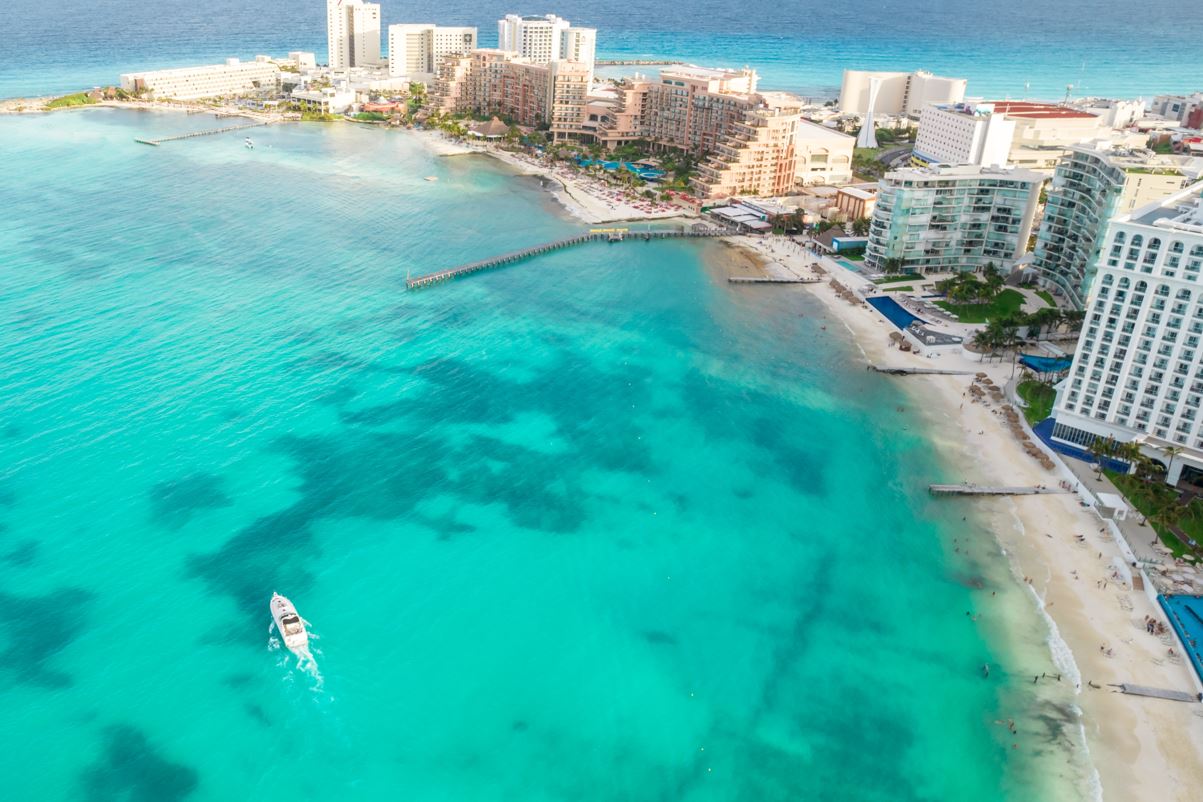
1. Cancun, Mexico
Cancun regularly tops the list of most popular destinations for American travelers, especially those from the East Coast.
This Mexican destination is set to reach 95% occupancy rates this winter as Americans flock to its beautiful beaches to escape the cold.
On the Pacific Coast of the country, many Americans are discovering that they like Cabo more than Cancun. Cabo is known for its stunning beaches and for being the “wellness capital” of Mexico.
3. London, England
Many Americans are heading across the pond this Christmas, with London topping the charts for most popular European destinations.
London at Christmas is a magical experience. The city’s streets are transformed with Christmas lights and decorations, and there’s so much to do, from seeing the iconic Big Ben clock to visiting Buckingham Palace to admiring the Crown Jewels at the Tower of London.
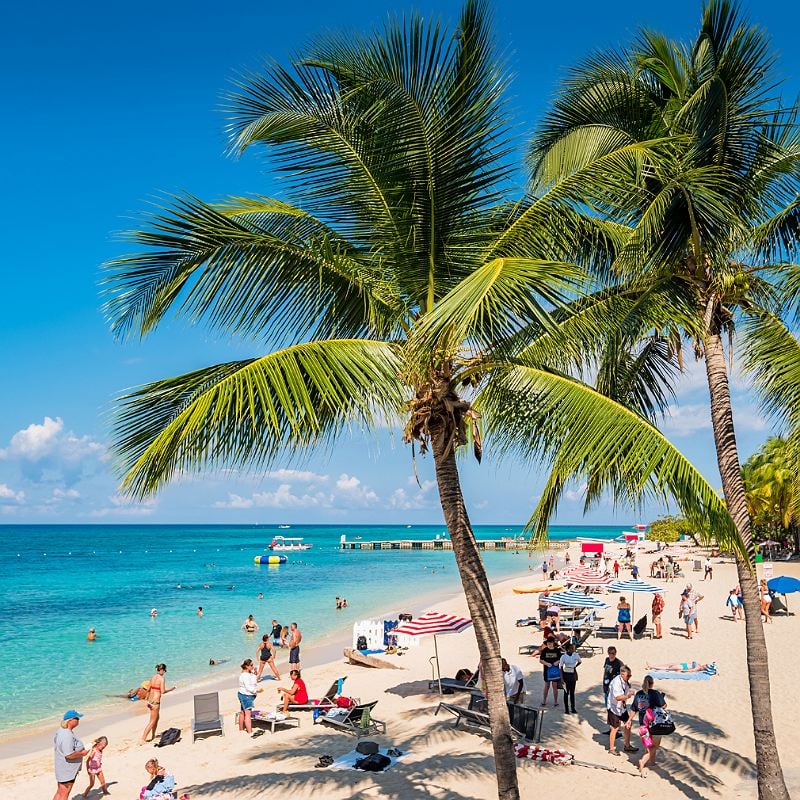
Sunny Jamaica is another one of the top international destinations for Americans this Christmas.
If you want to escape the cold winter weather back home, there’s nowhere better to go than Montego Bay, where you can sip a cold drink on the beach and listen to the sounds of reggae music.
5. Puerto Vallarta, Mexico
Another Pacific Coast destination in Mexico that’s popular with Americans is Puerto Vallarta.
This city is known for its great beaches, water sports, and nightlife. If you’re looking for a fun Christmas getaway abroad, you’re guaranteed to find it in Puerto Vallarta.
6. Nassau, Bahamas
The Bahamas are a chain of islands that are in close proximity for many U.S. travelers, just 50 miles away from Florida.
Visitors are attracted to Nassau because of its great beaches, resorts, and beautiful coral reefs, popular with scuba divers and snorkelers. Short and frequent flights from the U.S. make this island destination an easy getaway for American travelers.
Punta Cana is a popular destination because of its beautiful beaches and affordable all-inclusive resorts. For a Christmas getaway that won’t break the bank, this is a great place to go.
8. Oranjestad, Aruba
Although it’s a little more far-flung, located in the Southern Caribbean not far from the coast of Venezuela, Aruba has long been a tourism hotspot.
With plenty of resorts, beautiful beaches, and nightlife, Aruba’s status as “One Happy Island” makes it a great place to spend a tropical Christmas.
9. Providenciales, Turks and Caicos
For a truly unforgettable Caribbean vacation, many Americans head to Turks and Caicos. These islands are a paradise on Earth, with white sandy beaches and clear turquoise waters.
Turks and Caicos is known for being a great scuba diving destination. It’s also home to many luxury resorts if you want to splurge on a relaxing Christmas vacation.
10. Paris, France
Finally, Paris is another European destination Americans are heading to this Christmas.
The City of Love is more beautiful than ever around Christmas, with decorations, lights, Christmas markets, and holiday shopping.
Although the majority of the most popular international destinations for travelers involve warm weather, sunshine, and tropical beaches, Paris is a great choice for travelers who want to experience Christmas in Europe.
Mexico is an extremely popular destination for American travelers. Americans account for the largest percentage of tourists in the country, with millions visiting the country every year.
In 2022, Mexico’s popularity with Americans has continued to grow, with destinations like Cancun and Puerto Vallarta breaking records. In the first quarter of 2022 alone, more than 3 million Americans visited Mexico.
It is also the top country for American expats, with as many as one million Americans living temporarily or permanently in Mexico.
Mexico is popular with Americans due to its beautiful beaches and nature, exciting cities, delicious food and great culture, affordable prices, and close proximity to the United States.
For Americans planning to visit Mexico soon, here are several key things to know about Mexican culture before your trip:
1. Tipping Is Customary In Mexico
Unlike some international destinations in Asia or Europe where tipping is not a thing, it’s customary in Mexico.
Much like in the United States, it’s expected that you leave una propina for restaurant servers, bartenders, valets, hotel maids, and other service workers. At a restaurant, 10% to 15% of the total bill is an appropriate tip.
In more touristy areas, a gratuity may be automatically added to your bill at a restaurant, in which case an additional tip is not needed.
In many popular destinations in the country, you’ll have no trouble finding fluent English speakers within the tourism and hospitality industries.
However, in total, only 12% of Mexicans speak English as a second language (which is still much higher than the percentage of non-Hispanic Americans who speak Spanish as a second language.)
This means that English is not as common in Mexico as some American tourists might expect, especially away from the most touristy areas.
Learning basic Spanish before visiting Mexico will go a long way, making it easier to communicate and get around the country.
3. Prepare For A Slower Pace Of Life
There’s a slower pace of life in Mexico when it comes to many things, some positive and some negative.
Long, unrushed meals with friends and family and the traditional afternoon siesta are examples of Mexico’s more relaxed pace of life. Shops often close earlier and may not open at all on Sundays or holidays, and there’s less of a 24/7 culture like the U.S. has.
However, this can also be a drawback because things can take longer than some Americans may expect, and there’s plenty of slow-moving bureaucracy in the country.
4. There’s Always Something To Celebrate In Mexico
Mexican culture is incredibly vibrant. Family, friends, and community are extremely important in Mexico.
You’ll find that someone is always celebrating in Mexico, whether it’s unique holidays like Día de Muertos (Day of the Dead), Semana Santa (Holy Week), Navidad y las Posadas (the Christmas season), and Día de la Independencia (Independence Day.)
Parades, processionals, decorations, and other events are common during holidays in Mexico, along with special meals. Weddings and birthdays (especially quinceañeras) are also a big deal.
Many Americans may find the country to be shockingly noisy, with fireworks and loud music common at any time of day, but that’s just part of the culture and day-to-day life in Mexico.
5. Mexican Culture Is Incredibly Diverse
Despite pervasive stereotypes Americans may be familiar with, Mexican culture is not a monolith. It’s actually incredibly diverse.
Mexico is a blend of many different cultures, including Indigenous, European, African, and mestizaje (mixed.) Although Mexico is an 80% Roman Catholic country, there is also still significant Indigenous influence.
More than 300 languages are spoken in Mexico, and the diversity of the country can be seen in its varied destinations, from electrifying cities to ancient Aztec ruins to picture-perfect colonial towns.
The U.S. Department of State is currently recommending against travel to six states in Mexico, giving them a Level Four – Do Not Travel travel advisory.
Seven additional states in Mexico have been given a Level Three – Reconsider Travel warning.
These travel advisories may give Americans pause when considering whether or not to plan a trip to Mexico.
But should Americans actually be concerned about these travel warnings and avoid travel to Mexico?
Here’s what you need to know about the current travel advisories for Mexico:
“Do Not Travel” Advisories for Mexico
It’s important to note that a Level Four – Do Not Travel alert is not a travel restriction. It just means that the U.S. Department of State strongly recommends against travel to a specific destination.
However, Americans are still free to travel to these places.
Currently, the U.S. Department of State suggests avoiding all travel to six Mexican states: Colima, Guerrero, Michoacán, Sinaloa, Tamaulipas, and Zacatecas.
While there are certainly areas in each state that Americans would want to avoid, these are places that tourists would not be visiting in the first place.
Applying a broad “Do Not Travel” warning to entire states ignores that there are many places within these states that are very safe and offer lots of tourist value.
For example, although the entire state of Sinaloa is designated as Level Four – Do Not Travel “due to crime and kidnapping” threats, there are a number of places in Sinaloa, like Mazatlán, that are very safe and beautiful.
Similarly, Acapulco and Zihuatanejo in Guerrero, the monarch butterfly reserve in Michoacán, and Colima city in Colima are safe for tourists to visit.
“Reconsider Travel” Advisories For Mexico
Like with Level Four – Do Not Travel alerts, a Level Three – Reconsider Travel alert from the U.S. Department of State is not a restriction but rather a recommendation to avoid non-essential travel to certain places.
In Mexico, seven states currently fall under a “Reconsider Travel” alert, including several that are extremely popular with tourists, like Baja California and Guanajuato.
If American travelers were to “reconsider travel” to these places, they might miss the stunning beauty of the colorful city of Guanajuato or the magnificent beaches of Cabo, which was recently ranked as the best destination in Mexico.
Once again, these travel advisories lack nuance and are overly cautious regarding destinations that are completely safe for tourists to visit.
Should Americans Worry About U.S. Travel Alerts For Mexico?
According to Kashlee Kucheran, founder of Travel Off Path and long-time Mexico expat, the answer is no:
“I feel that the U.S. Department of State has unfairly placed a Level Four – Do Not Travel advisory on the entire state of Sinaloa, including the touristic city of Mazatlán, which definitely does not deserve such a harsh warning.
I’ve been living in Mazatlán for four years now, and I personally feel much safer here than I do in the majority of the United States. Crime in general, but especially against tourists, in Mazatlán is almost nonexistent. The people here are extremely polite, welcoming to foreigners, and very interested in a peaceful, happy life.”
While it’s always important to exercise caution and take basic safety precautions while traveling in Mexico or anywhere else in the world, Americans should not be scared off from visiting worthwhile destinations just because of U.S. Department of State travel alerts.