For many decades now, Barcelona has been the leading destination in Spain for Americans. Surpassing Mallorca and Ibiza, and even the country’s own capital, Madrid, it draws in tens of millions of tourists every year with its Gaudí monuments and coastal location.
Gorgeous as Barcelona may be, however, there is a strange storm on the horizon…
From the overtly anti-tourist stance authorities have taken to the widespread local protests and every accommodation tax increase in between, Barcelona no longer feels as welcoming as it once must have been, and even U.S. travelers are starting to feel the heat.
Not the good kind of heat.
Perhaps it’s not too far-fetched say that, soon enough, Barcelona could be overtaken by another Spanish gem, and if there was ever a runner-up, it’s surely Seville:
Americans Are Flocking To Seville In 2025
The vibrant capital of Andalusia, a culture-loaded region in Southern Spain known for its Moorish heritage and sun-drenched coast, Seville is attracting a growing number of American guests as of late.
More specifically this summer, Americans have logged 39,943 nights in the city, only behind the Czechs, that accomplished 49,476, according to new data shared by Spain’s National Statistics Institute (INE).
In other words, the U.S. is already one of the most important sources of tourism revenue for the Andalusian hub, and that’s no small feat, considering Seville does not host nonstop Transatlantic flights, and it’s a whole 50 miles inland from the Mediterranean.
You heard it, no beaches. If that’s what you’re looking for, try Malaga. Now, if you love vibrant city breaks, epic European architecture, and you’re a devoted foodie, you’ve come to the right place:
Moorish Charm & Grandiose Squares
Without question, a huge part of Seville’s appeal is its ensemble of architectural marvels, which feature among some of the most impressive not only in Spain, but all of Europe.
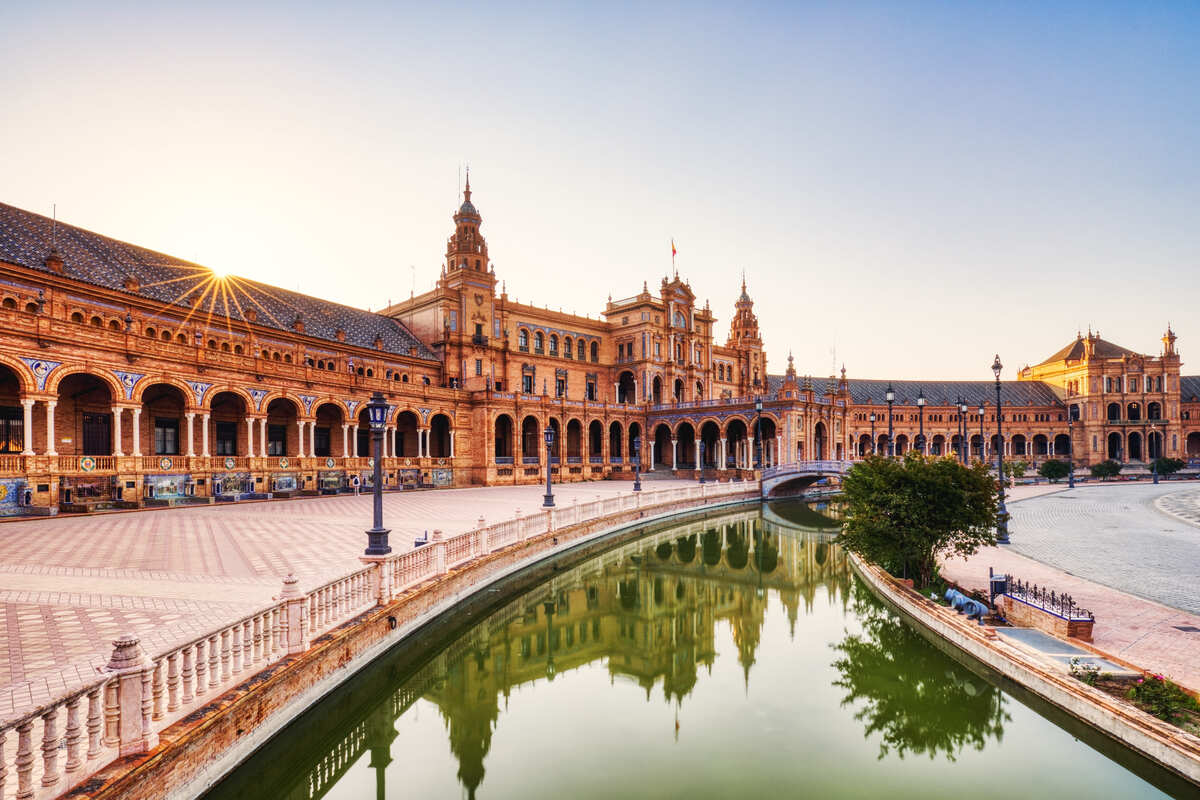
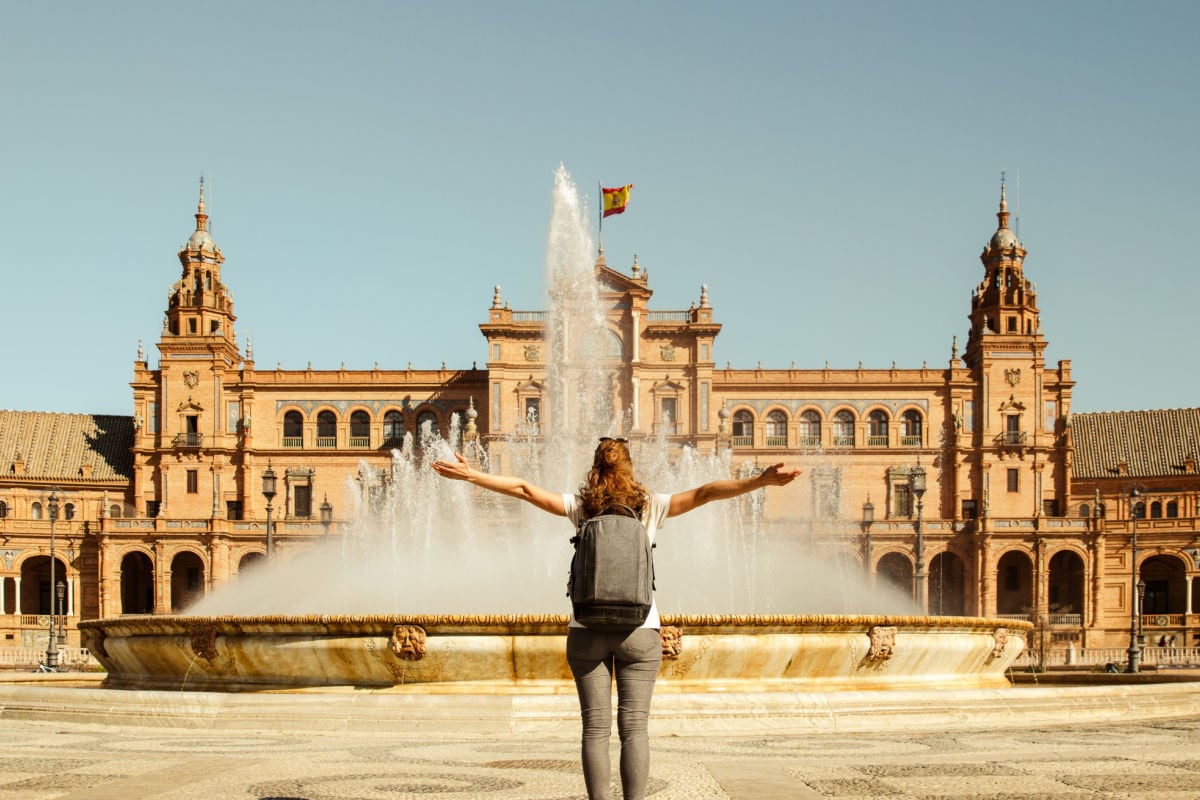
Think a grandiose Plaza de España, a public square that’s often described as the most beautiful in the country, with its tiled alcoves representing Spain’s different provinces, and a half-moon, navigable canal.
Then there’s Seville Cathedral, with its Giralda, a former minaret that’s been converted into a belfry: in case you didn’t know, North African rulers controlled large swathes of Spain for many centuries, and the square-shaped tower is an important leftover of the Muslim era.
Seville’s pride and joy, however, has to be the Alcázar: an Islamic royal palace with ornate stuccowork and lush Mediterranean gardens, it is the most memorable Moorish structure still standing today.
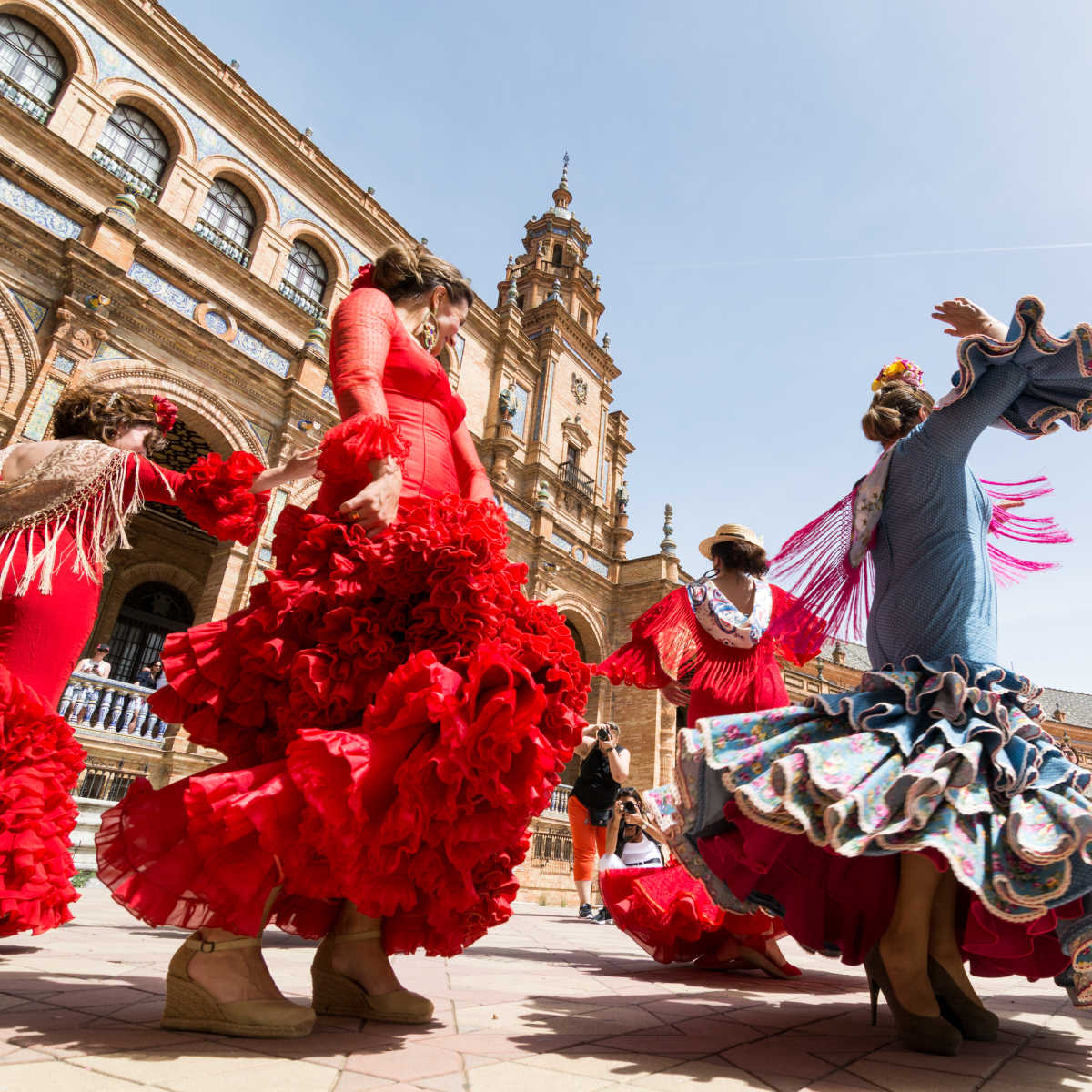
Further afield, in Barrio Santa Cruz, you’ll find a vibrant Jewish Quarter criss-crossed by narrow lanes that lead to hidden patios and tapas bars, and if it’s some fun you’re looking for, with flamenco shows and a lively nightlife, try Triana across the Guadalquivir River.
Is Andalusian Food The Best In Spain?
Barcelona may get all the fame for its paella and Catalan stews, but little do they know Seville is the true gastronomy capital of Spain.
Say what you will, the cuisine here is truly on a whole other level, thanks to its combination of native Iberian flavors, characterized by seafood-heavy and fresh local ingredients, and Moroccan influences: Andalusia is, after all, the closest point between Spain and Africa.
For salt cod and gambas tapas from only $3, check out the traditional Andalusian bodega of Dos de Mayo, in the heart of the Historic Center. Craving Iberian meat cannelloni instead? We couldn’t recommend Bar Sal Gorda highly enough.
Seville is popular for its herb-heavy patatas bravas(think French fries, but the spicier Spanish version), and there’s truly nowhere better to try those than at Duo Tapas Bar. Of course, no visit to Andalusia is complete without trying salmorejo:
Seville’s coup de coeur, this cold tomato soup is your best bet at an easy-on-the-tummy, refreshing meal amid the scorching heat, and if we’re keeping it within tradition, El Rinconcillo is the place to go. Established in 1670, it’s proclaimed the oldest tapas bar in Seville, and they serve a killer salmorejo.
How to Get To Seville From The U.S.
As we noted previously, there are no direct flights between Seville and the United States as of right now, though given the city’s rising popularity, this is likely to change at some point in the future.
Meanwhile, there are a handful of inventive ways Americans have used to get there with the least possible transfers. They can involve flying into a Spanish (or European) hub that offers direct flights to Seville, or combining flights and trains.
Landing in Madrid or Barcelona, for example, you can find train tickets from as cheap as $25 one-way booked in advance. From Madrid, it’s a short 2h33 ride to Seville, whereas from Barcelona, it’s a significantly longer 5h33, and tickets tend to be on the pricier end.
Alternatively, you may fly from as cheap as $26 roundtrip from either cities, or when landing in other European countries:
Paris to Seville: direct flights from as cheap as $36 roundtrip
Rome to Seville: direct flights from as cheap as $25 roundtrip
London to Seville: direct flights from as cheap as $50 roundtrip
Amsterdam to Seville: direct flights from as cheap as $52 roundtrip
Vini, our senior lead writer at Travel Off Path, has over 60+ countries under his belt (and currently weaving tales from Paris!), and a knack for turning off-the-beaten-path experiences into informative stories that will have you packing your bags.
The Travel Off Path Advantage: Your Travel Toolkit
Subscribe To Our Latest Posts
Enter your email address to subscribe to Travel Off Path’s latest breaking travel news, straight to your inbox.
Deep in the heart of Arkansas, hugged by scenic mountains, winding waterways, and charming small towns, lies a historic city that is too often overlooked against the usual mainstays of the South.
Being the most notable destination in Arkansas, Little Rock is one of those cities big in size with a small town feel.
However, there’s far more to Arkansas than the pretty riverfront skyline and fresh home-cookin’. Beyond the city life lies some truly astounding nature, living up to the ‘Natural State’ motto.
There’s one city that particularly thrives in the fall months, boasting the oldest National Park in the country and some off-the-wall ways to relax, making Hot Springs a truly unique getaway.
Not Your Average Water Destination
If you’ve never been to Hot Springs, you can probably imagine how its name came about.
Yes, Hot Springs’ hot springs are a big hit, drawing in tourists to soak in the nearly 150-degree waters.
While a heatwave rages through multiple states, and even Death Valley has seen record-breaking temperatures, there’s no better way to enjoy off-the-charts thermometers than nature’s jacuzzi.
Many travelers are still in search of sun and sand even in the fall, but visiting Hot Springs is a different kind of experience, and it is drawing rave reviews!
Hot Springs is located in Arkansas’ lush Ouachita Mountains, where there’s more to do than you might suspect in a city of less than 40,000 residents.
From scenic trails and thermal springs for outdoor enthusiasts, historic bathhouses for the ultimate relaxing spa day, and an underrated food scene, Hot Springs is more than meets the eye in Little Rock’s big shadow.
Move Over Yellowstone! This Is America’s Oldest National Park
Yellowstone may be the first designated U.S. National Park, but Hot Springs National Park has been around far longer.
Initially established as federally protected land, Yellowstone may have beaten Hot Springs to the punch of official ‘designation ‘National Park’ status, but Hot Springs has had a seat at the table for nearly 2 centuries and was recently hyped up by National Geographic.
As September has arrived in the blink of an eye, expect the same with the area’s rush of fall colors.
A burst of vibrant reds and rustic oranges tend to arrive mid-October, hitting their stride well before Thanksgiving.
But as gorgeous as this park may be to explore in search of the perfect sweater weather photo-op, it’s the 47 thermal springs that are the real draw.
As the old adage goes, “there must be something in the water”…well, in this case it’s true.
Hot Springs is very proud of their thermal waters therapeutic properties, creating an entire tourism around it.
While you cannot directly soak in the springs, there are ample ways to experience the region’s pure waters.
Hot Springs’ Historic Bathhouses
Ever been to a bathhouse? I have, and what an experience! My first time was in Istanbul at a traditional Turkish bathhouse.
First, I walked in to the wrong locker room (oops!), then I thought I was going to faint in the sauna, followed by an odd massage from another man where I still to this day have no idea why he had to undress with me, but I digress…
Cultural differences are certailnly real, but no need to worry about any awkwardness here as Hot Springs bathhouses are the cream of the crop and undoubtedly the top attraction.
In fact, there’s a whole district dedicated to them – Bathhouse Row. This is the best place to reap the benefits of Hot Springs, all while pampering yourself on the ultimate fall retreat.
Not your average spa day, you’ll find yourself taking part in a variety of water-related activities dating back to the 1830’s, along with massages, mud wraps, and facials.
Trust the process to soak in the natural minerals of the nearby springs. The most unique is Hotel Hale, the longest standing bathhouse originating in 1892.
Here, you can enjoy the thermal waters without having to step foot outside of your hotel room! Simply relax in your tub as water flows directly from the National Park springs.
Tip: Look for free parking at 128 Exchange St.
Home-Cooked Southern Comfort
Southern hospitality is the real deal. You’ll know it when you come across it, and it’s definitely not in New York City!
Throughout the South, there are some incredible food cities, such as New Orleans, Austin, Memphis, and Charleston, but many fly well under the radar – Hot Springs being one of them.
Don’t sleep on Arkansas’ local delights like fried pies. And yes, it’s totally okay to eat dessert first!
Sam, our Lead Writer & Journalist based in San Diego has visited 30 countries and written over 400 articles with a focus on sharing his own travel experiences and shining a light on lesser-known gems.
Opinions expressed here are the author’s alone, not those of any bank, credit card issuer, hotel, airline, or other entity. This content has not been reviewed, approved or otherwise endorsed by any of the entities included within the post.
I’m not sure about you, but testing my patience in long waiting lines at the gelato shop or bumping into sweaty bodies in narrow alleyways teeming with excursion groups while it’s over 100 degrees outside is not exactly my idea of fun, much less relaxation.
Early summer is indisputably the best time to be in Portugal, especially if you’re traveling with friends or family: days are already balmy, but not scorching-hot, there are smaller crowds, though life is already in full bloom, and most importantly, prices are not as exorbitant as in August.
In fact, if you’re dreaming of an idyllic getaway where you can escape those mundane worries while soaking up some culture and spending actual quality time with loved ones, this historic Iberian villa is the perfect nest for exploring the country’s honey-colored coast.
Your home away from home, Almóada provides the seclusion of a private vacation rental in the heart of a sunny Algarve, in tandem with a boutique hotel service, and costs from only $250 per night to book this season, it’s arguably the best bang for your buck if it’s Portugal where you’re headed:
Europe’s Most Beautiful Coast Where The Sun Shines 300 Days Per Year
Before we delve into what’s a truly remarkable listing, you may be wondering what’s ‘The Algarve’. Unless you’ve spent some time studying a map of Portugal, you may be unfamiliarized with its regions, and as a professed Lusophile who’s explored the country extensively, allow me to enlighten you:
The Algarve is the southernmost region in mainland Portugal, a sun-kissed stretch of coast extending for roughly 100 miles, with beckoning golden sands as far as the eyes can see, turquoise waters lapping rugged shores, and postcard-ready cobbled towns perched atop small cliffs.
It’s been a popular holiday destination for Europeans for years, as it boasts summer-like temps as early as April, easily surpassing 77 degrees, and a highly-developed beachfront interspersed with resorts and centuries-old fishing villages.
Unlike other parts of Europe, the Algarve is never exactly quiet, per se, as it is blessed with over 300 perfectly sunny days on average every year, and tourist services remain operational year-round, attracting visitors from colder, Northern countries.
Irrespective of season, rest assured there’ll be sunbathers dotting the sand in Lagos, wild swimmers braving the Atlantic waters off Portimão, and young revelers out in polo shirts, drink in hand, pub-crawling around Albufeira.
In the midst of it all, there’s stillness:
Outside
Surrounded by green and tucked away in the mountainous hinterland of the Algarve, São Brás de Alportel is not your typical resort town: there are no luxurious five-star hotels, bohemian back streets, nor any obvious landmarks that would make it to the Tourism Office’s travel brochure.
Still, it is home to Europe’s newest, and arguably most promising wellness haven: Almóada is a four-bedroom holiday villa welcoming eight occupants at a time, born out of an Algarvian couple’s passion for hospitality and 19th century nostalgia.
This is the culturally-charged Old Continent, after all, so why go for the a bare, lifeless hotel room when you can stay instead in a period house that was built brick by brick, and once belonged to a solitary farmer and his son?
It may have been left in ruins upon the demise of that family line – countryside Portugal wasn’t exactly prosperous back when – but where the odd onlooker might have seen overgrown vegetation and decaying walls, the brilliant minds behind Almóada saw an opportunity.
Pulling up to the dirt road leading down to the house, a striking chalky white against a verdant landscape, I was immediately taken aback by how well-equipped it was, considering it rests on the outermost edge of a tiny village in a wider, predominantly rural province.
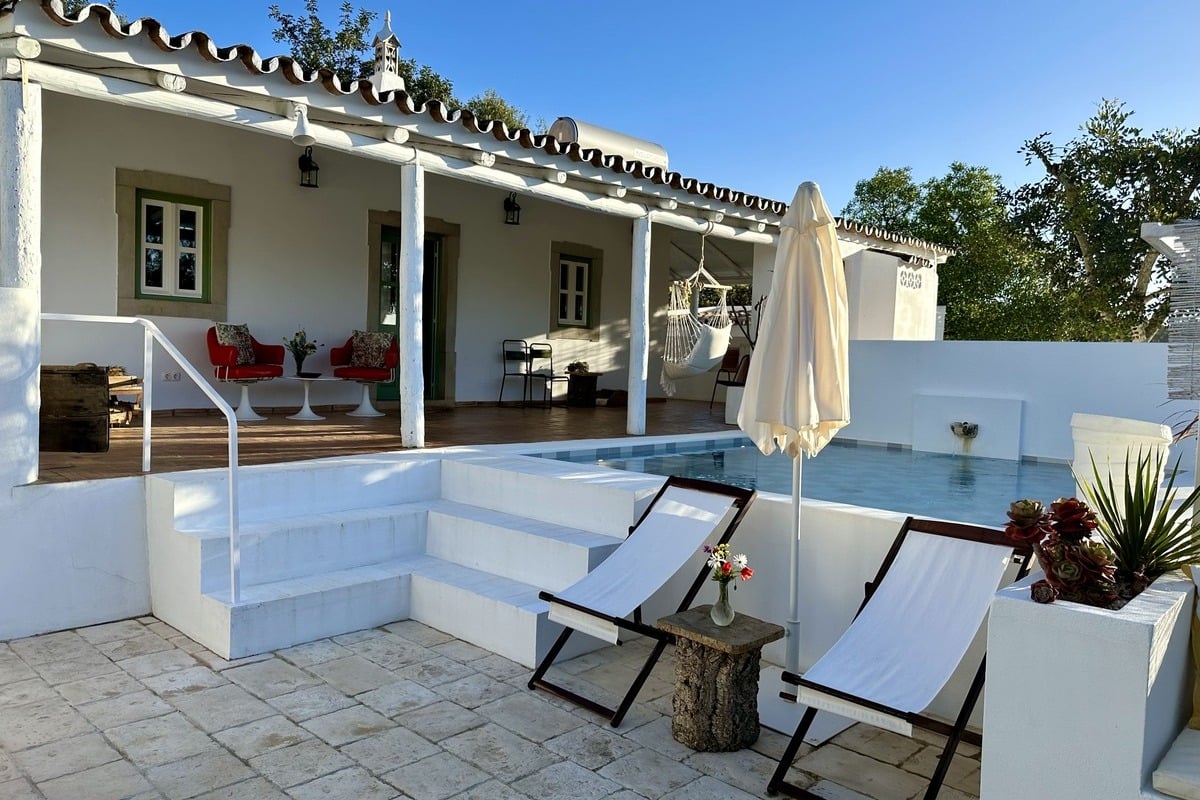
Unbolting the front gate, you will first lay eyes on a compact sunbathing area featuring an intimate, heated outdoor pool fed by a weeping fountain, cozy loungers under the shade of lemon trees, and even a hammock that swings over the crystalline waters.
It adjoins the spacious veranda that laps around the house, leading to an ‘honesty’ bar, filled with world-renowned Portuguese wines and spirits, alfresco dining spots, and other relaxation areas, including a daybed that was sure to become my reading nook for the time being.
No noise, no traffic, only the gentle ruffling of the leaves.
Inside
Crossing the threshold, my focus was immediately diverted to the homespun, timeless feel of the interior: from the century-old dial phone and the neatly-carved wooden furniture, to the retro posters stuck to rammed-earth walls and the absence of a TV set, it exuded sophistication.
I’m no art buff myself, but I was deeply impressed by the fact that no interior designers were employed in bringing this place to life: the careful selection of Albert Jacob restchairs, industrial Jieldé lamps, richly-woven Moroccan carpets, and even their configuration is entirely the owner’s doing.
As stated previously, there are four bedrooms in the property, each of them coming with soft pillow-top mattresses of the kind you’d most commonly find in luxury hotels, and minimalist, bedside dim night lights that only add to the overall romantic ambiance.
The antiqued decoration follows you into the shower rooms – out of three in the property, two are en-suite – where there’s a number of well-storied heirlooms, including a tabletop radio with the unforgettable baskelite casing, vintage hardbooks, and melancholic Portuguese rag dolls resting on wall shelves.
Despite the impressive attention to detail – many of the items look like they belong in some History museum – this is still an incredibly-modern holiday villa: the kitchen, however rustic-looking, is furnished with a toaster, kettle, microwave, and every paraphernalia kitchen frequenters need to have handy.
I was unaccompanied during my stay, and though I wouldn’t be doing any cooking myself when Almóada guests can opt for a private chef service (more on that in a minute), it was still nice knowing there are cooking amenities available if you’re looking for a more convivial atmosphere with friends.
Portuguese Hospitality
Portugal is well-known for its hospitality, especially pertaining to Americans.
Contrary to the French, who can be somewhat dismissive of you, or Germans, who come across as blunt at times, the Portuguese will offer friendly smiles and go out of their way to ensure you feel right at home.
Needless to say, Almóada embodies that warm Portuguese spirit: it is first and foremost a family project, captained by Ricardo Beltran and his wife Cristina, two vintage aficionados who poured their hearts into making the house what it is today.
My interactions with them set the tone for the entire stay: not only did they keep in contact with me throughout the entire booking process, to ensure my needs would be met prior to arrival, they welcomed me to homecooked dinner and good-natured conversation on night one.
Ricardo and Cristina are well-versed, well-traveled, they speak multiple languages – their native Portuguese, English, French and Spanish, out of those I could count – and most importantly, they’re natural hosts:
I felt as if I was being greeted by long-time friends I hadn’t seen in yonks, yet at the same time, they spared no effort in making sure my needs were fully met before handing over the keys to their beloved house, as dictated by boutique hotel policy.
What Sets Almoada Apart From The Rest
I may have dropped a hint or two already as to why the Almóada is special, and while I haven’t had the chance to fully elaborate on that until now, the name of the listing itself should give you an idea: let’s just say it’s not called a boutique home for no apparent reason.
I’m a hotel guy through and through, but I do love booking private holiday rentals from time to time, mostly when I’m looking for complete quietness and privacy.
None of the smiling to strangers, exchanged pleasantries and restricted liberties.
Swimming starkers in the pool, not having to moderate your singing, making full use of the amenities available without having to share, nor time your sleep as the breakfast room closes by 10 a.m. can feel quite freeing, particularly in a setting as tranquil as the Algarvian countryside.
What if you could have all that, and still get pampered, and the same standards of luxury and personalized service you would be offered in a boutique hotel?
Almóada is yours for the weekend, but if being left to your own devices feels too isolating, there’s alternative arrangements in place:
Idyllic Vibes With A Touch Of Luxury
Can’t be bothered with the kitchen or ordering food?
You can have your own private chef who comes round to the house at pre-scheduled hours to cook for you.
Don’t fancy rocking up to town to get groceries for the weekend ahead? The Almóada concierge is more than happy to take care of that for you.
Missing spa facilities? Their wide range of massage services and tried-and-true therapies can help you release that built-up tension after another laborious year in the office.
Whether you’d rather have minimal contact with the Almóada team, only meeting them for check-in and check-out, or enhance your villa stay with a boutique service, they’re ready to accommodate your every preference and need.
Your only job is to sit back and live your best Epicurean life.
Speaking of which, can we talk about the culinary triumphs concocted here?
UNESCO-Listed Gastronomy And Wine Aged In Clay Vessels
If you’re not yet sold on the nostalgic feel of staying in a renovated 19th-century homestead, but you’re a devoted foodie, perhaps Almóada’s gastronomy efforts could be enough of an incentive to book a prolonged stay.
At the end of the day, this is several-millennnia-old Europe, so of course local food would be cooked and presented in delicately-molded pans and tableware made out of black Bisalhães clay, listed by UNESCO itself as an intangible cultural heritage of Portugal.
There’s just no fooling tastebuds, and as my host Ricardo explained to me the first night, the material helps keep the meal warm long after it’s out of the oven and preserves flavor, contrary to inexpensive utensils that often leave food with a tarnishing vestige of plastic.
Dinners at Almóada are season-based, as every ingredient is locally-sourced – none of the overprocessed stuff sold in Aldi – so it’s best to check in advance what’s on the menu before ordering a homecooked dish, but on my inaugural dinner, I was treated to:
A reinvigorating muxama salad, with sliced prosciutto of tuna harvested from the Algarvian coast, pesto and acidic local orange, which aided in cleansing my palate for the main course, slow-cooked, steamy seafood bean stew.
The full meal, from starter to dessert, was paired with smooth Portuguese wine you wouldn’t easily find in your local supermarket. No, sir: these ones are matured in clay vessels, a unique tradition exclusive to Portugal and Georgia (the latter of which is the actual birthplace of wine).
The true star of the evening was the carob cream with red fruits, granola, and a generous scoop of plain ice cream on the side. If you’re wondering what’s a ‘carob’, don’t worry, as you won’t be the first guest to be puzzled by this delicacy:
It may look like your regular açaí bowl, but the closest equivalent to carob, or how the Portuguese call it, alfarroba, would be cacao, except carob tastes richer, and it’s arguably a lot healthier than the stuff chocolate is based on.
I would sample carob again during breakfast in powder form, sprinkled over a bowl of curd. The early morning banquet is simple, but efficient: French croissants au beurre, Portuguese bread rolls, tropical fruits, a cheese plate and freshly-sequeezed oranges.
I wouldn’t be surprised if these were handpicked from gardens in the vicinity, though I wouldn’t know as it was already magically set on the table outside when I finally woke from my slumber.
Lie Back, Relax.
As the years have gone by, and my blogging-induced tech neck’s got worse, the prospect of massage sessions in the midst of leisure getaways has started to sound all the more appealing, and there was no way I was leaving it here without putting their holistic therapies to the test.
Through their partnership with the Carma Project, a clinic based in Faro, this holiday villa-boutique hotel hybrid has a rather exhaustive list of wellness products available to guests on demand, and the best thing is, you don’t need to leave the comfort of home to access them.
From facial aesthetic procedures to coaching to therapeutic rub-downs, you’ll have no trouble finding just the right treatment to complement your sojourn.
As a travel blogger with chronic back pain, I was immediately drawn to their highly recommended full-body massage.
I’m glad to say the masseur did not disappoint: she came round to the house on the scheduled time, and I was free to choose a location for the massage table to be set up myself, by the poolside, listening to the gentle trickling of the nonstop fountain.
By the end of the session, my back felt a lot less tight, and I could feel all those knotty muscles around my neck had been finally released. It goes without saying that night, I had my best sleep in weeks. 45 minutes that go by way too fast, and worth every extra cent.
The Town It’s Located In
The Almóada sits on the outer edge of São Brás de Alportel, a laid-back town some 10 miles inland from Faro, the regional capital of the Algarve, and an equally-short 22-minute drive from Faro International Airport, where you’re likely to touch down first.
There are no beaches for miles nor a resort scene, but that does not mean it lacks cultural value: other than the numerous pastelarias serving Portuguese morsels and the camaraderie of locals, there are a couple of noteworthy landmarks within walking distance of the house worth seeing for yourself.
The Old Town is picture-perfect, with rows upon rows of low houses and the occasional ornately-tiled façade, and if you’re a History buff like me, you should probably know there’s a Roman road leading all the way to a hilltop 16th-century church.
It’s called Calçadinha, Portuguese for ‘small pathway’, and it was once part of a larger system of roads that connected the city of Faro to Beja, in the north, back when the Algarve, and most of modern-day Portugal, were part of the Roman Empire.
There’s not much to see here, besides the thriving nature, but it’s still pretty cool to be able to say you’ve retraced the steps of Ancient Romans walking the 1,480-meter, partially-preserved steps.
As you might imagine, there’s not much of a nightlife in São Brás, and evenings are for chill walks around town or casual dinners in local restaurants, on nights your private chef won’t be around. In that case, I strongly encourage you to pay Sal da Serra a visit.
The Best Restaurant In Town
One of the hidden gems of the Algarve, this roadside, Iberian-style restaurant some eight minutes walking from the house serve the best dourada ceviche you’ll ever have, sprayed with Algarve lime, and only-moderately salted.
Their melt-in-the-mouth, sunk-in-olive-oil codfish, redolent of Portuguese tradition, is another must-try, and I was positively surprised by the lemon mousse. Not the most elaborate of desserts, but the creaminess of it was nothing short of delightful.
As I’ve learned, staying a couple of nights at the Almóada, sometimes simple, is best.
On The Downside…
The main feature missing here is a TV, so there’ll be no binging of your favorite series, nor popcorn and movie nights if you’re coming with friends.
I get it, the Almóada is somewhere you go for blocking out the outer noise and experiencing that slow life in rural Portugal, and this is a deliberate choice of the owners to make it a more immersive experience, and it’s an inherent part of the concept, however…
Albeit somewhat distracting, late-night TV binging can be a great way to de-stress and connect with loved ones – I’ve shared some of my favorite moments with loved ones before a flatscreen watching silly rom-coms, or edgy, experimental horror films.
Then again, you’re unlikely to notice the house lacks a TV when there’s an ample selection of board games lying around, certain to keep kids entertained, a whole bookshelf at the convenience of readaholics, or you and your friends can always hit up the honesty bar.
Additionally, I noticed there wasn’t a clothing iron around in the house, as I suppose most guests are not traveling light like me, and squeezing all of their outfits in an 8kg, Ryanair-friendly underseat bag, though the Almóada team was quick to produce one upon request.
As I mentioned already, the Almóada is located in a non-touristy town of the Algarve, away from the overdeveloped coast. While that’s great for the odd crowd-wary traveler, if you’re looking for a more lively atmosphere, you may find the experience somewhat isolating.
Not Your Average Tourist Town
The town it’s located in, São Brás de Alportel, is a modern municipality, with supermarkets, restaurants and a shop-lined central square – there’s even a fairly-decent Lidl – but don’t expect to find the same level of preparedness to host tourists as in Albufeira or Lagos.
If you’re not coming with a car, and you plan on seeing more than just São Brás de Alportel, you may find it challenging to get around. Unlike other municipalities in the Algarve, there’s no train station, and bus options can be limited.
There is still regular bus service between Faro and Loulé, the two largest cities in the vicinity, but they run on long intervals, and there may be some delay. If you’re still resisting renting a car, you can alternatively book a Uber.
They are surprisingly affordable in Portugal, and the ride from the airport or downtown Faro to São Brás will only set you back by a negligible $10 – $13 on average. From Loulé, the nearest major city, it’s an even cheaper $9 in off-peak hours.
Who Is The Almóada For?
The Almóada caters to a diverse group of travelers, solo adventurers like me, who warmly embrace the associated recluseness and freedom of a villa retreat, but also families and groups of friends, and if the Homage Club, adults-only ‘secret’ room is any indication, even passionate honeymooners…
The only excluded demographic is children aged under 12. You know, you wouldn’t want the beautiful memorabilia to be damaged.
It’s ideal for a three-night to one-week stay, as it is in the heart of the Eastern Algarve, within short driving distance of all the main points of interest and the airport, and it may even serve as a temporary homebase for digital nomads.
As you’ve seen by now, São Brás de Alportel has everything you could need for a longer stay, and the fast, reliable Almóada WiFi will keep you connected, and your workflow uninterrupted if you’re booking the house for one to three-months.
How Much Does It Cost To Book The Almóada?
This listing is on the market for $250 per night this season, and that’s the maximum overnight rate you’ll be charged if you’re staying by yourself, but there’s no denying it is a far better deal if friends or family are tagging along.
The house has an 8-guest capacity, so when it’s full, each visitor will actually be paying a nearly-negligible $31.25. I’m talking thirty bucks for a luxury villa in the Algarve, with your own private pool and all these incredible amenities.
I know rounding up eight friends can be a challenging task when you have maybe three to four mates yourself. Still in that case, the nightly rate per person drops to only $62.50.
If it’s just you and your other half, you’ll be forking out an acceptable $125 each per night.
Quotations may vary depending on season, the types of services demanded – the private chef and concierge service are not included in the basic rate – and remember, each stay is completely personalized based on a guest’s every need.
It’s best to contact the team beforehand to make specific arrangements.
Either way, if you’re dreaming of an idyllic escapade to sunny Southern Europe, I doubt you’ll find another property with this much character and with better value for money than Almóada.
What To See And Do In The Algarve
São Brás is all lovely and picturesque, but there’s so much more to see in the Eastern Algarve, and trust me, you’ll want to extend your stay beyond just a couple of nights to get a proper feel of the surrounding province.
Out of all the fun things you could do, my four favorites were:
Go For Some Beer Tasting At Algarve Rock
Southern Europe is not exactly known for its varied selection of craft beer, even though a majority of tourists are heavy beer-drinkers, with Brits, Germans and North Europeans dominating in this precise demographic. Instead, wine is the law of the land.
You can imagine my surprise upon finding out one of the activities offered at Almóada is beer tasting at a newly-opened Algarve micro-brewery, where they serve dozens of unique beer flavors, blending the earthiness of ale and citrusy, Mediterranean undertones, and other unique combinations.
Their charcuterie plate with various types of cured ham and olives is a treat on the side, and if you’re a beer aficionado keen on learning more about the brewing process, there will most certainly be an enthusiastic member of staff available to give you a tour of the premises.
As for my favorite craft beers, I’d have to go for ‘Rasperry Goose’, the ‘Tiny Rhubarb’, and as odd as it may sound, the coconut-infused ‘Tino’s Great Escape’. Lucky you, you can always hoard up a few cans to get the party going back at the house.
Visit Beautiful Faro
Faro is the regional capital of the Algarve, and as it is a 24-minute drive from the village, there’s nothing stopping you from taking a day trip out to its walled historic center, traversed by narrow cobbled lanes that lead up to an imposing medieval cathedral.
Faro Cathedral was built in defiance of the city’s Moorish traits, and it’s stood for centuries as a symbol of Portuguese – and Christian – control over the land, that for many centuries, had succumbed to occupation by North African caliphates.
Other than the adorable Old Town, the most memorable thing about Faro to me was the Bone Chapel, a tiny oratory adorned by actual human bones, all four walls all the way up to the high ceiling: quite eery, perhaps distressing for some, but a striking sight nonetheless.
Get Lost In The Nature
Driving east of Faro, you’ll immediately enter the Ria Formosa Natural Park, a nationally-protected coastal marshland dotted with islands, interconnected by small canals, and bounded by unspoiled sandy beaches that run for a whopping 37 miles.
If you’re a birdwatcher, you’ll be thrilled to know there are numerous rare species you can spot here, as it is an oasis for the Atlantic wildlife: white storks, the rare spoonbill, distinct for its long, spoon-shaped beak, and the showstopper Greater Flamingo.
For the odd naturist out there, some of the islands in the zone are even reserved for nudism, and can only be accessed with small boats, giving beachgoers a unique sense of exclusivity, tying nicely with your recluse Almóada escapade.
Stroll The Charming Medieval Streets Of Loulé
Though not widely promoted, the small inland city of Loulé, a 19-minute drive down the N2 from the villa, is just as incredible a cultural expedition, with its gorgeous fortress, erected in immemorial chivalric times, and labyrinthical Old Town.
As it does not straddle the coast, unlike Faro, Loulé sees very few tourists, despite its relatively large Medieval Fair in July, and a host of other season-based festivities taking place here, but then again, only those with an interest in the Middle Ages are likely to have heard of it.
Oh, and if in strolling around this charming municipio, you happen to walk past the Amendoal Pastelaria, make sure you head in and order yourself a slice of their pata de veado (deer’s hoof), rolled in shredded coconut.
You can thank me later.
Explore An Ancient Roman Archaeological Site
Can’t get enough of the culture yet? Some 5 miles south of São Brás, near the village of Estoi, you’ll stumble upon an important archaeological site called Milreu: it comprises the ruins of a 1st century Roman villa and an uninhabited medieval farmhouse.
What makes Milreu special is the fact that it serves as a window into life in a rural province of the once-vast Roman Empire, and even so, it did not lack resourcefulness or luxury: I was surprised there were pools, a gym, lush gardens now overtaken by weed and a temple.
Excluding the 16th century house built atop the previous Roman dwelling, with removed floors so the beautiful mosaics beneath them can be seen, this temple is the main attraction, and judging by its state of semi-preservation well into the modern age, it must had been really quite something.
The Algarve extends well beyond Faro and its surrounding points of interest, and we strongly suggest you do your own research in advance, and plan your itinerary based on your own preferences. This accompanying article is a good place to start.
Bottomline
I can’t think of a better home base to experience the nature and ancient wonders of the Algarve than Almóada: yes, it is a little off-path, and the boutique service comes at an additional cost, but it does feel like home, as opposed to another unremarkable hotel devoid of soul you’re just crashing in.
To me, it felt like a safe haven nestled in the Algarvian hills, still within short driving distance of the beach and a number of historical sites, yet you get to kick it back, relax, and escape the hustle and bustle of the tourist-ridden coast all the same.
With their private homestay approach, without sacrificing comfort, and enhanced by a boutique hotel service, it’s almost as if the team at Almóada has cracked the code to the ultimate guest experience, and rest assured I’ll be back myself this summer.
Portugal hosts a number of nonstop Transatlantic flights from the United States, a majority of which will land in Lisbon and Porto, two of the country’s largest cities.
That said, in recent years, due to the surging demand for Portugal vacations, other secondary hubs have emerged.
We’ve had States-bound service launching from both the Azores and Madeira, two Portuguese archipelagos stranded in the middle of an azure Atlantic, and from this summer onward, it’s Faro’s turn to dip into that growing North American market.
Starting May 24, Americans can fly from Newark International straight to Faro, in the heart of the Algarve, without long, unnecessary layovers in Lisbon or Porto, with United Airlines, a total of four times per week, on a 176-seat Boeing 757-200.
Newark To Faro Flight Schedule
Outbound
It departs from Newark every Sunday, Monday and Wednesday at 9:50 p.m. local time, touching down in Southern Portugal at 10:00 a.m. the next morning.
Return
Returning home, every Monday, Tuesday and Thursday, Americans should expect to take off at 11:45 a.m. landing back in Newark at 3:05 p.m. local time, on the same calendar date.
One-way tickets start from $944, or only $84.15 in monthly instalments if you select uplift as a payment option upon checkout. For more information, head on over to United Airlines.
The Almóada is a 22-minute Uber ride from the airport, with fares ranging between $10 and $15 depending on the hour.
**Travel Off Path was a guest of Almóada, who helped with the creation of this itinerary by hosting some of our accommodations and attractions. Our opinions, recommendations, and suggestions remain our own.**
Vini, our senior lead writer at Travel Off Path, has over 60+ countries under his belt (and currently weaving tales from Paris!), and a knack for turning off-the-beaten-path experiences into informative stories that will have you packing your bags.
Opinions expressed here are the author’s alone, not those of any bank, credit card issuer, hotel, airline, or other entity. This content has not been reviewed, approved or otherwise endorsed by any of the entities included within the post.
Then the stunning historical cultural city of Athens should be on your list!
More American travelers are visiting than ever before, and tourist satisfaction in the city has increased considerably in the last 10 years.
Here are 7 reasons why this historic cultural city is soaring in popularity with American travelers:
A Year-Round Destination
Athens isn’t just a summer vacation spot. It is becoming a year-round destination, and American travelers are taking charge of this shift.
In 2023 just over a million U.S. travelers visited Athens which is more than double the number that arrived in the previous record year of 2019.
Many of Athens’ best and most famous attractions, such as the Acropolis and the Panathenaic Stadium, can be enjoyed year-round.
However, many American tourists have shown that they prefer to visit them during the winter months when the temperatures are more manageable, and the crowd levels are much lower.
The Archeological Sites
One of the main reasons to visit Athens is for its stunning archeological sites. The city is the birthplace of democracy and home to some of the greatest examples of classical art and architecture in the world.
The most popular of these archeological sites is the Acropolis, which is an ancient citadel located on a rocky outcrop above the city.
This site is so popular that the government has introduced a daily cap of 20,000 to the site in order to limit the crowds.
83% of leisure visitors to Athens will visit the Acropolis.
Other archeological sites you shouldn’t miss during your time in Athens include the Theatre of Herodes Atticus, the Ancient Cemetery of Kerameikos, and the Temple of Olympian Zeus.
The Delicious Food
Greek food is some of the best in the world.
Fresh salads, delicious souvlaki wraps, and tables loaded with meze dishes mean that every mealtime is an experience in Greece, and a chance to relax and reconnect with family and friends.
Because Athens is the country’s capital you really are spoilt for choice when it comes to places to eat. Food prices in Athens are reasonable too, so even budget travelers can enjoy the local cuisine.
As in most countries restaurants are considerably more expensive in the main tourist areas, so we recommend you seek out restaurants catering to locals.
Restaurants packed with locals almost always offer the best value and the best dishes too.
Shop In The Markets
If you’re shopping for luxury goods, there are better places to visit in Europe. But if you’re looking for gems and quirky pieces, the markets of Athens are well worth exploring.
You can chat with stallholders, look at unusual items, and get a real taste of Athenian culture. Many of these markets are popular with locals as well as tourists.
The markets in Athens are a great place to buy souvenirs while learning about the products and their origin and meaning, often from those who made or produced them.
Excellent Nightlife
If you want to party the night away, then Athens is a great place to be. The nightlife here is legendary and for good reason.
Just don’t expect an early night as most bars don’t get the party started until around 10pm when the daily temperatures have cooled, so you’ll be partying until the early hours.
Some of the best nightlife spots in the city include Kavouras bar for live Greek music and the 360 Cocktail Bar above Monastiraki Square, where the drinks are as good as the incredible views of the city.
Beautiful Beaches
Because Athens has a reputation for being a grimy, urban city, people often don’t realize just how close the city is to the coast. Less than 14 km south of the city center, you will find a beautiful stretch of golden sand beaches with blue-flag-certified clean waters.
The cove of Skalakia Agias Marinas is one of the most beautiful and famous of these.
The beaches of Athens are great place to enjoy water sports such as windsurfing and paddle boarding.
A Gateway To The Greek Islands
Athens is incredible but it is also a noisy, busy city with very little green space.
For this reason many travelers choose to use Athens as a stopover on route to a more relaxing vacation on one of the many Greek islands.
If you land in Athens, you could fly straight back to your preferred island. But most people choose to spend a few days exploring the city and then travel to the Greek islands by ferry. This tends to be not only cheaper but also a more picturesque way to travel.
Piraeus is Athens’s central port, but many ferries also depart from the ports of Rafina and Lavrion.
Opinions expressed here are the author’s alone, not those of any bank, credit card issuer, hotel, airline, or other entity. This content has not been reviewed, approved or otherwise endorsed by any of the entities included within the post.
The world is an adventure playground for solo travelers, and no destination has caught their attention more than Europe.
Europe tops the charts for being home to the safest, most interesting, and culture-rich solo travel spots.
But which city is the best of them all? A new report has found this city is affordable, has a low crime rate, and offers exceptional solo traveler experiences.
Here’s why this historic city was voted the best in the world for solo travelers:
A Safe City
Prague is highly sought after by solo travelers because it is known to be one of the safest cities in Europe.
Though there is crime in Prague, this tends to be petty theft and street crimes, with the violent crime rate in the city very low.
The U.S. Department of State has given the Czech Republic a Level 1 advisory rating, which is the lowest rating available. This means that U.S. citizens should exercise normal precautions in the country and that it is a very safe country.
Like all travelers, solo travelers should take extra care with their belongings in crowded places and especially on public transport. But otherwise, you will feel very safe, even after dark, as a solo traveler in Prague.
Best For Budget Travelers
Prague has long been known for being one of the most affordable destinations in Europe, and although prices have increased in recent years, that is still true today.
Everything you need as a traveler can be found for a reasonable price in the city.
Research has found that it costs around $45-$65 per day to visit Prague as a budget traveler.
Around $5 will buy you a hearty and delicious traditional lunch in a local restaurant. And as of January the price of a pint of beer was around $3 on average.
In most cases, it is cheaper to order a beer in a restaurant than it is to order a bottle of water. So if you needed an excuse for a lunchtime pint here it is!
Prague is more expensive than other Czech cities but it is still one of the most affordable European capitals you can visit.
So Much To See And Do
It doesn’t matter how long or short your trip to Prague, you’ll never run out of things to see and do. Prague is one of the oldest cities in Europe and it has the architectural diversity to prove it.
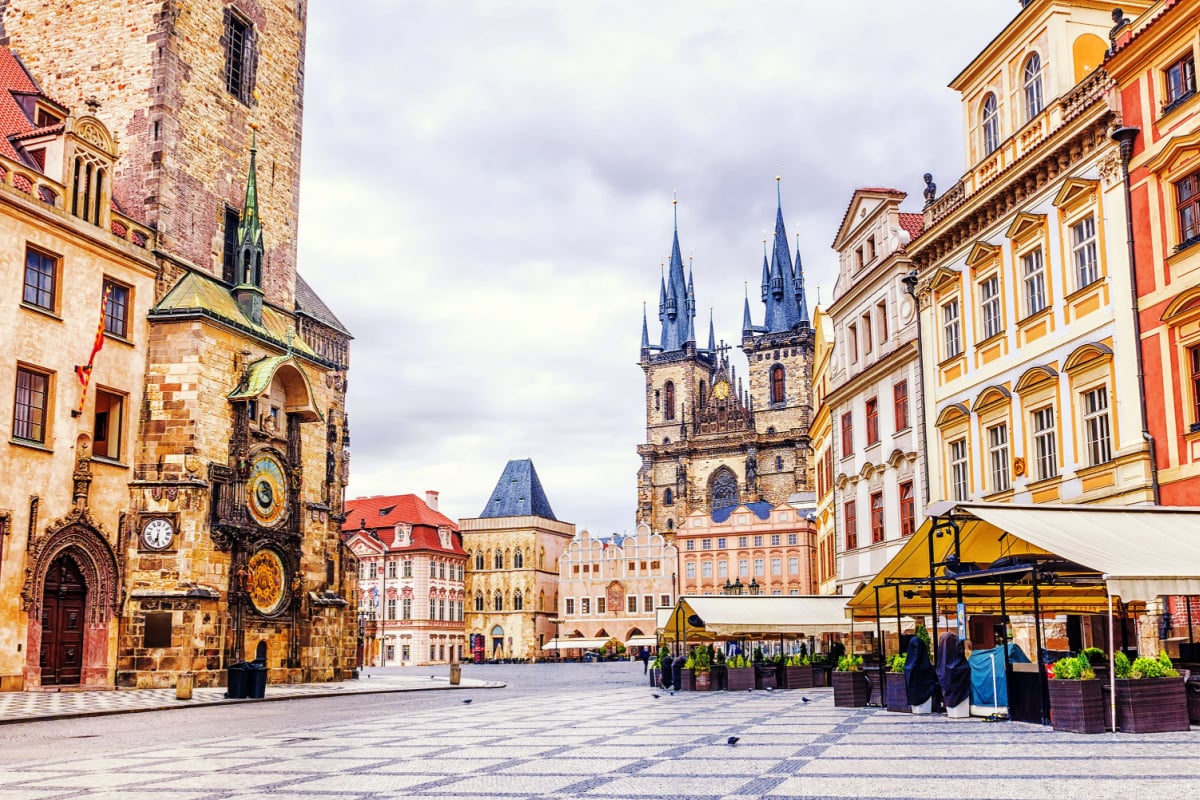
One of Prague’s biggest tourist sights is Prague Castle and it is well worth exploring. Other historical sights you shouldn’t miss on your solo explorations include the Charles Bridge, the Old Town Astronomical Clock and the Old-New Synagogue.
The Old-New Synagogue is Europe’s oldest active synagogue as well as being one of the first Gothic buildings in Prague.
Consider booking a tour around all of Prague’s historic sights when you’re traveling solo if you want to learn more about the attractions you’re visiting and meet like-minded travelers at the same time.
A Social City
Just because you’re traveling solo doesn’t mean you ever have to be lonely. And if you’re a social butterfly, then Prague is a great place to travel solo.
You’ll find an endless number of cafes, bars, and restaurants dotted across the city. These are great places to meet both local people and fellow travelers.
And if you’re taking a workcation or dipping your toes into the world of digital nomadism, then you’ll be pleased to hear that Prague is also a great place to be a remote worker.
There’s no shortage of places to socialize in Prague. pubs, beer gardens, art galleries, and creative hubs. The Muddum Art Space is a great place to take workshops, explore your inner creativity, and meet new people.
Extra benefits? Prague is an easy city to navigate as a solo traveler and the transportation system is incredibly affordable too.
And because the Czech Republic is a geographically small country, it’s easy to take day trips to explore more of what this wider country has to offer.
Opinions expressed here are the author’s alone, not those of any bank, credit card issuer, hotel, airline, or other entity. This content has not been reviewed, approved or otherwise endorsed by any of the entities included within the post.
Spain is one of Europe’s most popular tourism destinations, and with good reason. The country boasts vibrant cities, captivating coastlines, and warm, sunny weather for most of the year.
With the launch of Spain’s digital nomad visa this year, travelers will be keen to discover which places in Spain are the best to live, work, and explore.
While the bright lights of Barcelona may be appealing, there’s another historically fascinating city making a strong claim to become a new favorite among digital nomads.
Seville is the fourth largest city in Spain and the capital of the Andalusia region. It’s also somewhat of a cultural melting pot, blending history and traditions from Spain and North Africa.
This vibrant and modern destination was recently named as one of the European Capitals of Smart Tourism for 2023 thanks to several technology-based innovations launched by city planners.
These innovations paired with Seville’s charming architecture and lively culture make it an ideal place to live and work as a digital nomad.
It’s also one of the sunniest cities in Europe, with more than 2,800 hours of sunlight each year.
A Technological Trailblazer
Seville is using technology to help tourists have a more enjoyable and stress-free visit.
For example, the city has introduced more public transport options that use renewable energy in a bid to reduce traffic and improve air quality.
Seville also has a Tourism Intelligence System project that analyses crowds and people movements to prevent the most popular areas becoming too crowded. This has helped protect and preserve attractions.
City planners also recently introduced the Sevilla Accessible App, which allows visitors with mobility issues to plan routes that allow them to explore with freedom and using transport that suits their needs.
One of the must-see attractions is the Alcazar Real de Sevilla. This palace complex is still used by the Spanish royal family and has an architecture style known as Mudejar, showcasing the region’s North African influences.
The Plaza de España is another highlight. This famous square is actually circular in shape and is covered with 48 colorful mosaics that represented the 48 provinces the country had at the time of the square’s construction in 1928.
For modern art lovers, a trip to Las Setas de Sevilla, or Metropol Parasol can’t be missed. One of the world’s largest wooden structures, this timber canopy also houses an archeological museum in the basement and walkways with impressive views on its upper.
Another highlight is the Torre del Oro, a striking tower built in Moorish style that was part of the walls that once enclosed the city in ancient times.
Green Space To Take A Break From Work
Seville is known as one of the hottest cities in Europe, so it’s nice to know it’s also home to plenty of parks and green space to enjoy a stroll or relaxing afternoon under the shade of a tree.
Parque de Maria Luisa lies just south of the Plaza de España and will enchant you with its pretty buildings and pavilions as well as tranquil fountains and tree-lined avenues.
For a quieter experience, the Alamillo Park in the north of Seville runs alongside the river Guadalquivir and features smooth paved walking routes, an ancient aqueduct, and a nature observatory.
Across the river from the Plaza de España lies Parque de los Principes, a smaller park that lacks nothing in prettiness and features a small lake you can cross on a bridge.
About The Spanish Digital Nomad Visa
Spain’s digital nomad visa was introduced this year as part of the country’s StartUp Act. Here are some key things you should know about it:
The visa is open to anyone from a country outside of the European Economic Area.
You must prove your monthly income is double the Spanish minimum wage.
You must have been working remotely for at least one year.
You must not have been a resident in Spain in the last five years.
Spouses and partners can come too – but that involves an increase in provable income.
You can also work for a company in Spain, but that income must not exceed 20% of your total income.
The visa is valid for one year but can be extended into a temporary residency permit valid for three years once you’ve arrived in Spain.
Amsterdam is The Netherlands’ largest city and one of the main Dutch cities that tourists visit when taking a trip across Europe.
Amsterdam is known for its extensive canal system, cultural attractions, and museum district.
You can enjoy the artistic works of Van Gogh, Rembrandt, and Vermeer here or visit Ann Frank’s house, a museum dedicated to the Jewish wartime diarist.
Amsterdam’s famous nightlife attracts a lively and youthful crowd, and the city is a great place to explore both Dutch and global cuisine.
If you want to avoid the crowds that Amsterdam attracts, why not visit the equally exciting city of Leeuwarden instead?
Leeuwarden is a small but historically significant city in the municipality of Friesland, and it is just as beautiful as Amsterdam.
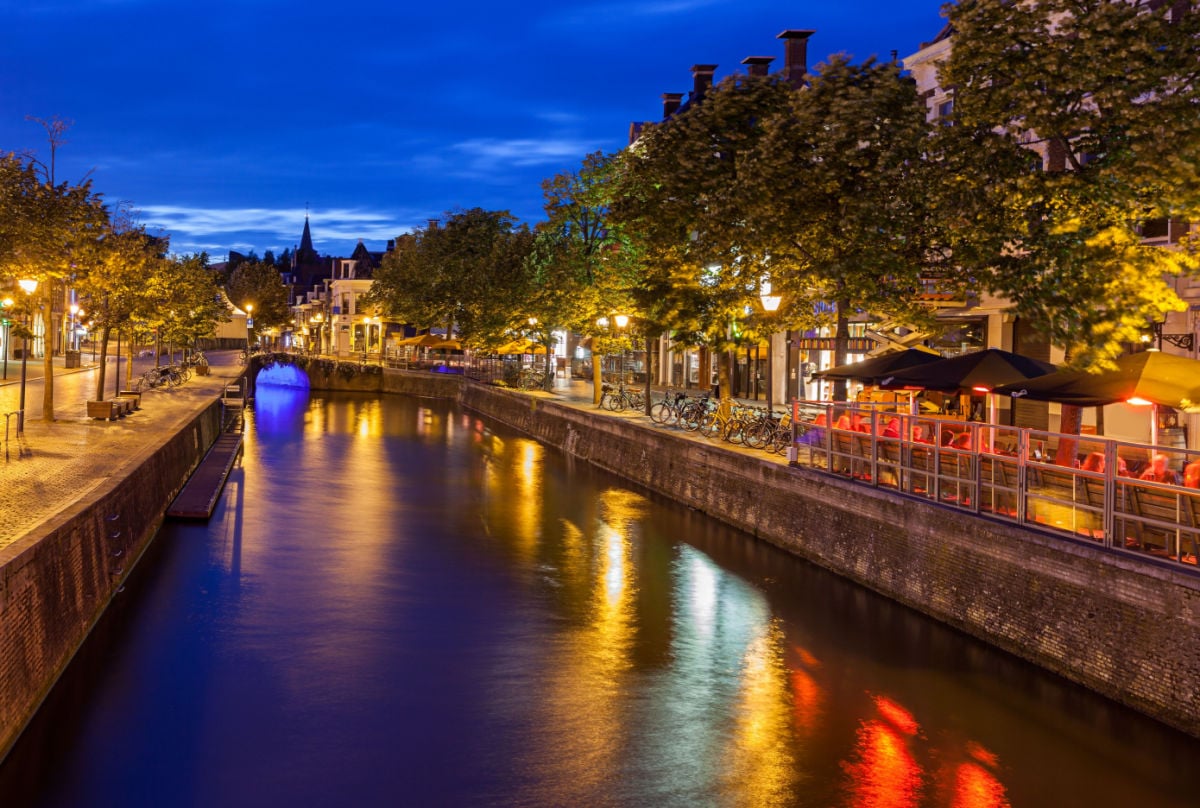
It has a similar canal system and was awarded the title of European Capital of Culture in 2018. It is everything you would expect when you think of a typical Dutch city.
Here’s why you should visit:
Small But Perfectly Formed
Leeuwarden is a city that is small but perfectly formed. With a population of just over 100,000, there’s no need to worry about overcrowding here.
Leeuwarden boasts a beautiful historic inner city that can easily be explored on foot, meaning you won’t need to navigate the public transport system, if you don’t want to. The historic center is home to over 600 monuments, the most famous of which is a tall leaning tower called De Oldehove.
Construction of the Oldhove began in 1529. The tower’s tilt began during its construction, so the project was stopped in 1532. Whilst the 9th Century church originally attached to the church was then demolished in 1595, the 39 meter tall tower still remains.
If you want to learn more about the history and culture of the Friesland region then you can visit the Fries museum, which sits in the heart of the historic inner city.
Visitors can also visit Stadhouderlijk Hof, now a hotel but formerly a palace owned by the Dutch Royal Family.
Nothing Is Lost In Translation
The Dutch language can be complicated and difficult to learn. But what makes Leeuwarden unique is that, unlike most other parts of The Netherlands, they don’t actually speak Dutch.
Instead, they have their own language called Frisian. And the Frisian language has more in common with English than Dutch!
Frisian and English share 80% lexical similarity, making it the Germanic language closest to English. This means that English speakers will find it incredibly easy to communicate and get around the city.
The reason? Friesland was once connected to England via a prehistoric land bridge known as Doggerland, which was submerged in water around 6500 to 6200 BC. Before this point, Great Britain was connected to mainland Europe via the Netherlands.
A Lively Nightlife Scene
When you think of nightlife in the Netherlands, you instantly think of Amsterdam. But Leeuwarden is a university town and thanks to its several higher education institutions, it has its own high-octane nightlife scene.
Like Amsterdam, the universities in Leeuwarden attract students from all over Europe, so the nightlife available is wonderfully diverse. You will find plenty of bars and clubs, as well as live music venues and other live performances.
Visit Doelesteeg, a small street packed with bars and clubs. This street is particularly busy on Thursday, Friday and Saturday nights, and is famed for its great atmosphere and late-night parties.
Beautiful Green Spaces
One of the main attractions of Leeuwarden is that it is in the heart of an area that boasts outstanding natural beauty.
You can sit by one of the many city center canals and enjoy the views with a cup of coffee, or even take a canal tour to explore the city from a different angle.
Locals often travel by bike, and it is possible to hire bicycles and explore many of the green spaces surrounding the city. From parks to cycle paths and hiking trails, you’ll be amazed at how much greenery there is in a relatively urban environment.
Ready to take time out of the city? You’re in the right place! Friesland is known for its lush greenery, and the Frisian Lakes are a popular place for water sports enthusiasts.
Consisting of 24 lakes spread across central and southwest Friesland, during the summer months the area attracts boaters from all over the country. Here you can sail, surf, or even try your hand at waterskiing.
Leeuwarden offers the best elements of a city break with all the fun of an activity-packed vacation at the same time.
The start of summer is right around the corner, and for many, the next holiday they have free from work is Memorial Day.
It’s no wonder that almost 40 million Americans travel during Memorial Day weekend, many favoring a road trip over air travel, and most of them staying within a 50-mile radius of home.
As the official start of summer, it’s natural that most people like to hit the beach for Memorial Day, but the crowds, traffic, and parking they face usually take away from the enjoyment of the trip.
One way to avoid the beach crowds is to head away from the shoreline and instead celebrate Memorial Day by checking out some more historic towns.
Luckily, as part of their 10 Best series, USA Today has named the top 10 historic small towns to visit across America.
While most of these places have some connection to war heroes or military history, they are all deeply steeped in history.
So, Just In Time For Memorial Day, Here Are the 10 Best Historic American Small Towns, According to USA Today:
San Elizario, Texas
This small Texan border town has a history of over 400 years and makes a perfect day trip from nearby El Paso.
According to the National Park Service, San Elizario was picked as a strategic point as a military stronghold on New Spain’s western frontier.
The town charms visitors with its adobe structures that have been historically preserved, as well as its San Elizario Presidio Chapel, located in the center of town.
There are a few reasons the small Kansas town of Abilene was chosen as one of the top 10 historic small towns in America, but the main one is that this is the hometown of 5 Star General and 34th President Of The United States, Dwight D. Eisenhower.
There is lots to do here, from wild-west reenactments to museums and historical sites, not to mention a thriving dining and hotel scene.
Wickford, Rhode Island
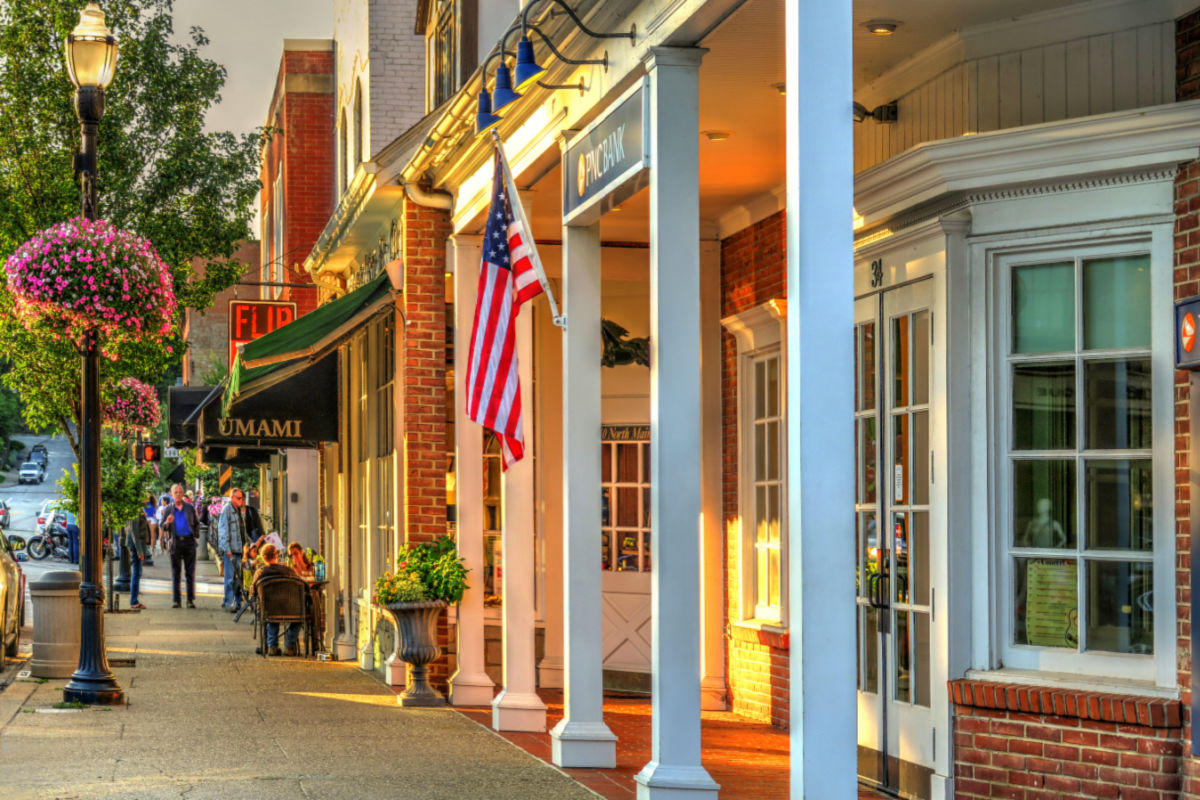
Those looking to stay by the shore can check out the historic harbor town of Wickford, loaded about a 20-minute drive from the larger and more well-known Newport.
Originally a small filing village, Wickford now showcases classic storefronts along its streets, colonial homes, fine dining options, churches, gardens, and many other laid-back sites to take in.
Wallace, Idaho
You can find this authentic and unique town in North Idaho, in the state’s panhandle.
Originally a mining town, it was destroyed by a fire in the 1900s known as the “Big Burn” and has since come into its own as a bigger and more tourist-driven town.
Once one of the largest silver producers in the world, Wallace now has many things to do, including mining tours.
Cody, Wyoming
Founded by William “Buffalo Bill” Cody in the 1890s in attempts to capitalize on the newfound tourism boom of the nearby Yellowstone National Park, Cody is one small historic town that should not be missed and makes an easy stop on any Yellowstone trip.
Don’t miss visiting any of the five museums, one being, of course, the Buffalo Bill Museum.
Wickenburg, Arizona
A classic gold mining town, Wickenburg now features a Historic Walking Tour, which offers visitors the chance to take in 30 sites of history.
One classic building is the iconic train depot, dating back to the 1890s.
Considered by some to be a desert oasis, this is one historic town that really can give those who visit a glimpse into the wild west.
Williamsburg, Virginia
Probably the most well-known town on this list, Williamsburg is not exactly a secret.
Though it’s still a small town at heart, visitors can take in Colonial Williamsburg, nearby Yorktown, and the Jamestown settlement.
Its cobblestone streets are still home to many horse-drawn carriages, and oak trees drip over white picket fences.
A major Civil War site, history buffs will love spending Memorial Day amongst the historic ambiance.
Yorktown, Virginia
Only 11 miles down the road from Williamsburg lies Yorktown, which is a charming place known for both its important place in U.S. history as well as its small-town waterfront feel.
It’s here in Yorktown that General George Washington led his army to victory over the British and secured independence for America.
Imagine watching a Memorial Day parade in a place as historic as this; the idea could win over even the non-military history fan in your life.
Mackinac Island, Michigan
OK, first things first. Mackinac Island has no cars. Like none. Nobody has a car for personal use, and people walk, bike, or take horse-drawn carriages to get around.
While here, visitors like to take in the scenic views on this three-mile-long, two-mile-wide island.
Since becoming a holiday destination in the 19th century, much has remained unchanged about this quaint little place.
Visit the historic forts and see some of the oldest houses in all of Michigan when you go, and make time for the amazing restaurants as well.
Port Gamble Washington
Port Gamble was once a booming town centered around the mills and used to be one of the main sources of lumber for many worldwide cities.
Now Port Gamble is a National Historic Landmark and has been called “the finest example of a nineteenth-centric Pacific Coast logging community.”
This quaint waterfront town seems straight out of New England, and some visitors come here for some spooky reasons.
Many of the historic buildings are said to be haunted, leading to the Port Gamble Ghost Conference each Winter.
The Dominican Republic has long been a popular vacation spot, and this year more than ever, tourists are flocking to this island nation in the Caribbean.
In February 2023 alone, over 600 thousand tourists arrived by air, and the trend shows no signs of slowing down.
With more flights being added from the U.S., travelers will keep coming to this stunningly beautiful tropical island, and for good reason.
While the beaches are obviously the draw here (as they should be), there are places inland worth a look at as well.
One such place is the vibrant and historic capital city of Santo Domingo.
Here’s Why You Really Shouldn’t Miss Out On Exploring This Gem:
Just A Capital City?
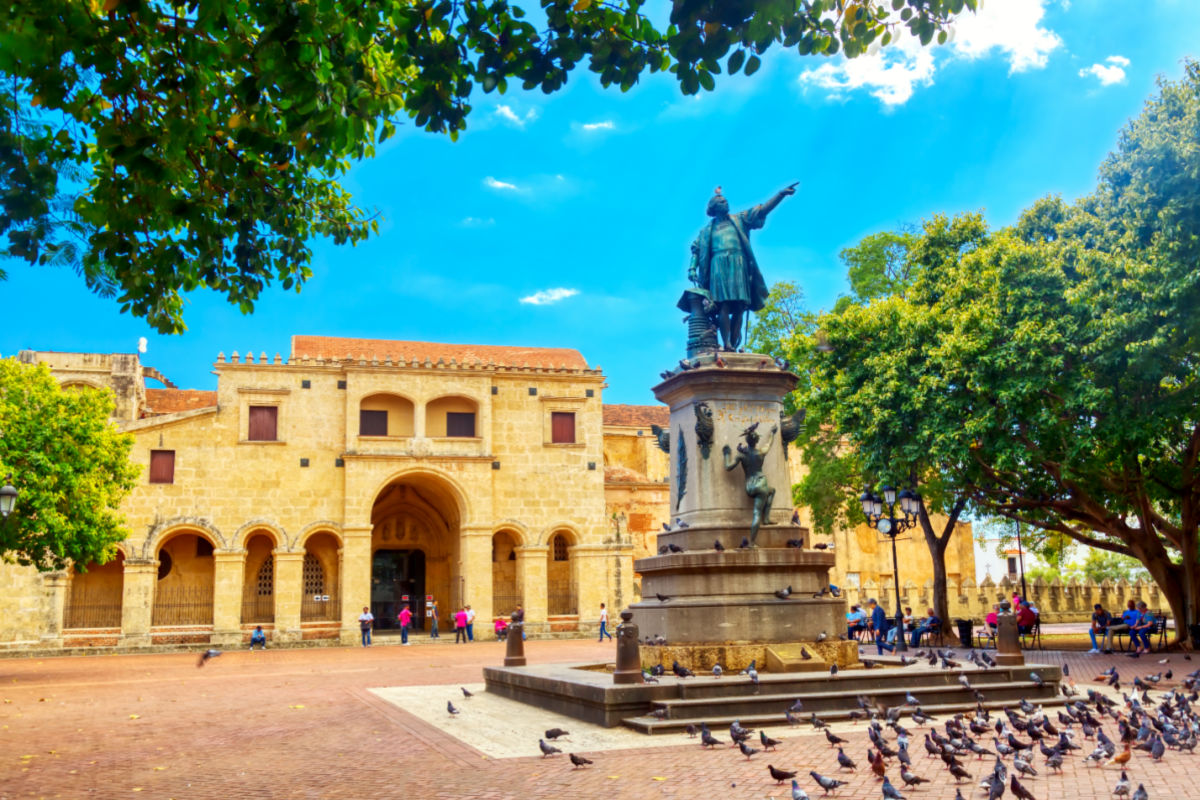
Founded in 1496 by Christopher Columbus’s younger brother, Bartholomew, Santo Domingo is the oldest continuously inhabited European city in all of the Americas. Here you will find the largest metropolitan city in the whole Caribbean and a colonial city that has been designated a UNESCO World Heritage Site.
A 2010 American Capital of Culture, Santo Domingo should be more than just your point of entry to this country. There are many reasons you should spend a couple of nights here before or after heading to the beaches, from history, nightlife, culture, food and drinks, and rooftop pools.
Reaching the beach areas from Santo Domingo is easy by car, and public buses are cheap and comfortable as well. Santo Domingo has UBER, so getting around the city shouldn’t be an issue, and there are areas to stick to and areas that are not suggested for tourists.
Note: Santo Domingo is a huge sprawling metropolis, and new areas are sprouting up over time. This article will focus on the main tourist draw of the Zona Colonial.
The best place to stay in Santo Domingo for tourists is the Zona Colonial or Colonial Zone. This is where you will feel the safest, be within an easy walk to many of the main sites, and be able to pop back to your accommodation for an afternoon cool down before heading back out for some fantastic nightlife.
Santo Domingo gets hot, as one might expect, and wandering the cobblestone streets all day will defiantly wear you down if visiting in the warmer months, so don’t overdo it. Luckily, there are many accommodation options with pools, perfect for an afternoon cool down.
Zona Colonial is not all that large, but luckily there are numerous rentals and boutique hotels here. Be careful when choosing where to stay, as some properties list themselves as being just outside the Colonial Quarter, and a few of these areas are not places to walk around at night.
Note: I am not saying they are ‘dangerous’ per se, but that they might not make the average traveler feel as comfortable as a more central location.
If possible, stay IN the Colonial Zone, not ‘nearby’. The best tip for this is to read the reviews before booking, specifically look for mentions of “safe, walking, night,” etc. Tales from actual travelers will give you a much better picture of the area than the property description in most cases.
There are other areas of this large city that some travelers prefer to stay, such as Zona Universitaria, Gazcue, or the Malecon area, but honestly, if you are here to see the Zona Colonial, it’s best to stay here and save travel time.
There are also some urban beach areas here you might choose, but it’s likely that you will be heading to one of the more famous beach areas, so it’s better to wait for those.
What To See and Do
The best way to experience the colonial quarter of Santo Domingo is simply to wander and take it all in. However, unless you are glued to a guidebook, it’s best to join one of the city’s many walking tours. With a guide, you can hear the history and get a feel for the real heartbeat of this area.
Depending on when you visit, you will likely see A LOT of tour groups, most of the coming from cruise ships. Luckily they don’t seem to stay long and congest the streets, and shouldn’t interrupt your sightseeing too much.
There is also a small tourist train that put-puts its way around some of the streets with a recorded audio description of the sights. This is a cheap and fun way to see a bit without breaking a sweat.
TIP- take this little train to scout out nice photo spotsthat you can circle back for golden hour.
The many restaurants and bars in the colonial zone leave you spoiled for choice here, and there is something for everyone’s budget and tastes. Ranging from rooftops, historic buildings, and newer developments, you can find Dominican food and anything else you might want. One personal favorite for a killer view is Sugarcane La Casa Del Ron, where you can sip and overlook the first church in the Americas.
For beer lovers, there are also a few very cool breweries scattered in colorful old houses in the Zona Colonial. So, be sure to seek those out if you are here to sample some of the Dominican Republic’s craft beers. For some great gram-worthy pics, La Cacata Brewing is a vibrant little place serving awesome ales.
If you can tear yourself away from the food and drinks, there are many cultural things to see and do here as well.
Parks such as Independence and Columbus are worth a visit, as are the many museums and historic sites to explore.
Museum of the Royal Houses, Museo del Larimar, the Amber World Museum, and Alcazar de Colon are all popular options.
Santo Domingo also has the Caribbean’s first urban cable car, and while its main purpose is to make the daily lives of residents easier, tourists are welcome to enjoy it as well.
Take the clean and efficient subway or an Uber to reach the station and enjoy a birds of view of the real Santo Domingo, far from the glitzy tourist shop-lined streets of the Zona Colonial.
Can’t Miss
It’s a shame how many people miss out on Santo Domingo when coming to the Dominican Republic, and it’s even more of a shame that people come to Santo Domingo and miss out on one of its best-kept secrets.
Literally IN the city lies a small but stunning cave system that you can visit for next to nothing, and while you cannot swim in the blue waters, the views rival any cenote that you might find in Mexico.
The Tres Ojos (Three Eyes) National Park is a must-see when visiting Santo Domingo and makes an easy stop on the way to the airport if you can arrange with your driver to wait about 30 minutes for you. The cost for entry is about $2, and you climb down and experience the pools and caves surrounding you.
While not very large, this place is fantastic, and you feel a million miles from the highway that actually runs right next to the park.
To reach the most photogenic spot, bring a couple of extra dollars with you. I won’t spoil the surprise, but let’s just say there are ropes and a floating raft involved.