On our way to Paris to visit a fellow Travel Off Path-er (looking at you Vini!), we pulled the ultimate two-for-one travel trick: a free Iceland stopover on a transatlantic flight.
Both PLAY and Icelandair let you pause your journey in Iceland with no additional airfare, which is how a quick layover became a full-blown micro-adventure.
It also helps that Iceland ranks #1 on the Global Peace Index yet again—stress levels are low, and the scenery is off the charts.
It’s the kind of place that makes you want to hop in a campervan and hit the road stress-free… and that’s exactly what we did!
Our 48-Hour Game Plan (Feel Free to Steal This)
Day 1: Land Early → Blue Lagoon → Seljalandsfoss Waterfall → Vík
We landed at Keflavík (KEF) around 6 a.m., grabbed the free airport shuttle to Happy Campers, and picked up our van.
The crew there is dialed: fast orientation, a clever “leave-behind” shelf of traveler extras, and an unlimited Wi-Fi hotspot in the van.
That connectivity made maps, messaging, and a little work on the go effortless.
Right from the start, when we drove away in our van, I knew we had made the right call, skipping a hotel and opting for this experience instead.
After grabbing our van we drove about 20 minutes to the Blue Lagoon—the perfect jet-lag reset before hitting the road. Soak, shower, change in the van, brew a coffee, and roll out. (The lagoon sits conveniently close to the airport; prebook a timed entry.)
The ultimate jet-lag cure, powered by Happy Campers Iceland and the Blue Lagoon✨ There’s no better feeling than starting a road trip this refreshed and ready to explore. Our van is already our favorite travel companion!
If you’re looking at the prices and wondering if it is worth it… we did the same thing, trust me.
My honest take? It’s one of those tourist items you should check off your list at least once, but I would probably opt for one of the many other lagoons the next time we visit.
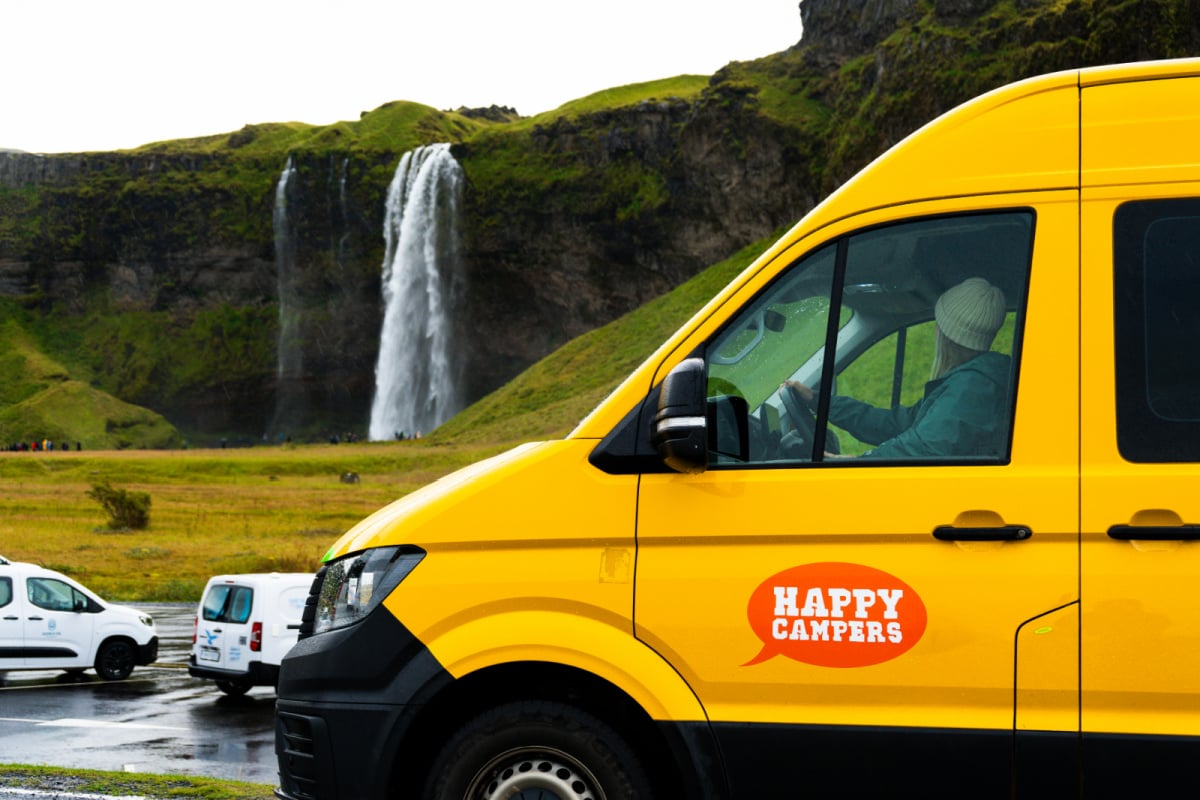
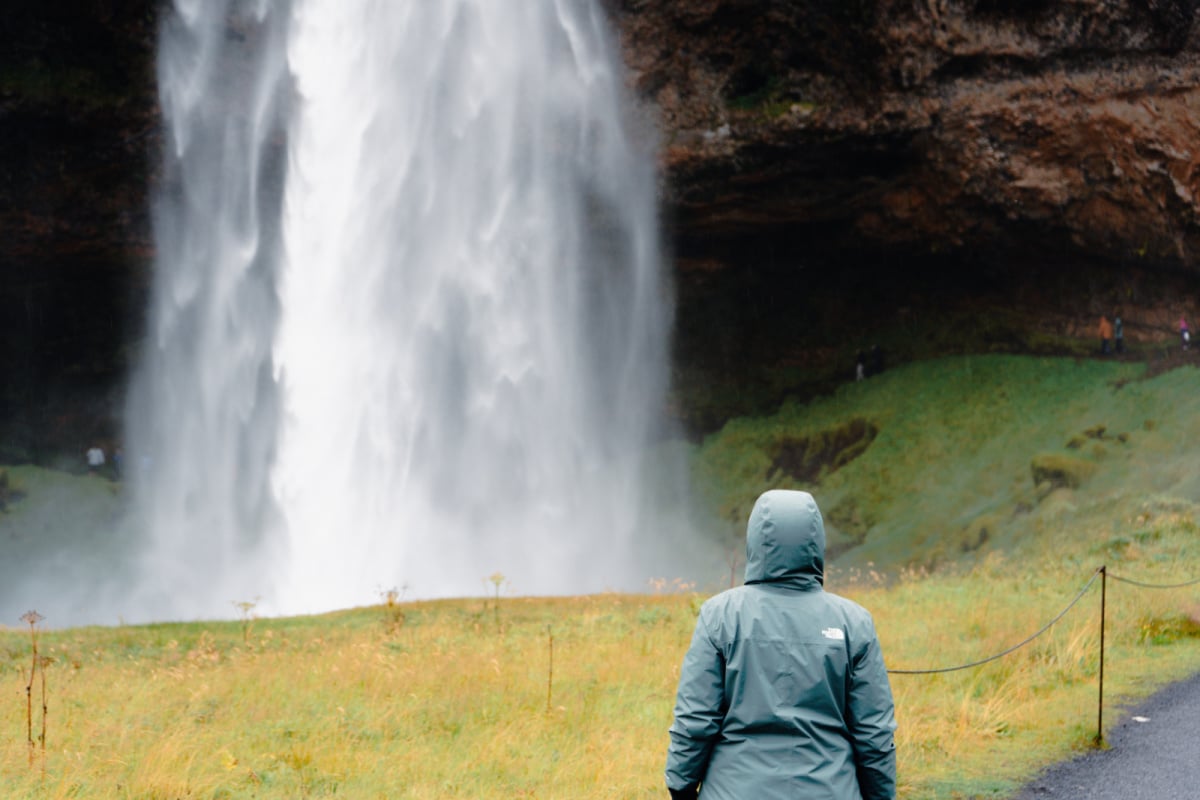
This is the South Coast classic with a path that lets you walk behind the 60-meter curtain—magical and very splashy, so bring a rain layer (you should pretty much always have one with you in Iceland, honestly).
We parked, hiked, and made a van-side lunch with the falls roaring in the background. It felt like we were living in a movie, and I am dreaming of going back asap.
We wrapped the day in Vík with dinner at Ströndin Pub Vík (comfort food + local beers) and an easy late check-in at Vík Camping—popular with other vans doing the South Coast sprint.
Facilities include showers, Wi-Fi, a shared kitchen area, and laundry.
Day 2: Vikurfjara → A Rainbow For The Ages → Reykjadalur Hot Spring River → Þingvellir
When we woke up the next morning, I jokingly started taking a video bragging about how gorgeous Iceland was as I opened the curtain on one of our van windows.
It had been pouring rain all morning, so I figured it would be a funny video to send to our Travel Off Path group.
However, while it was rainy, it was GORGEOUS. Seriously, every time I turned my head while we were in Iceland, something incredible would be staring back at me, rain or shine.
@traveloffpath Don’t just fly over Iceland, stop and explore it for FREE! 🇮🇸✨ Here’s the travel hack you need to know: airlines like Iceland Air and PLAY Airlines and let you book a stopover in Iceland for up to 7-10 days with NO additional airfare. We packed an entire adventure into just 48 hours, and the MVP of our trip was our van from Happy Campers. It was our transport, hotel, and kitchen all in one, giving us the freedom to see the best of the South Coast without missing a beat. In 48 hours, we: 💧 Soaked in the Blue Lagoon 🚶 Walked behind Seljalandsfoss waterfall 🌊 Watched the sunrise on Reynisfjara’s black sand beach ♨️ Hiked to a hot spring river 🌍 Walked between two continents at Þingvellir Renting a van from Happy Campers turned a quick layover into one of our most epic micro-adventures ever. The in-van Wi-Fi and 24/7 drop-off made everything completely stress-free. SAVE this post to plan your own Iceland stopover! You won’t regret it. #IcelandTravel#FreeStopover#TravelTips#HappyCampersIceland#IcelandAdventure♬ original sound – Travel Off Path
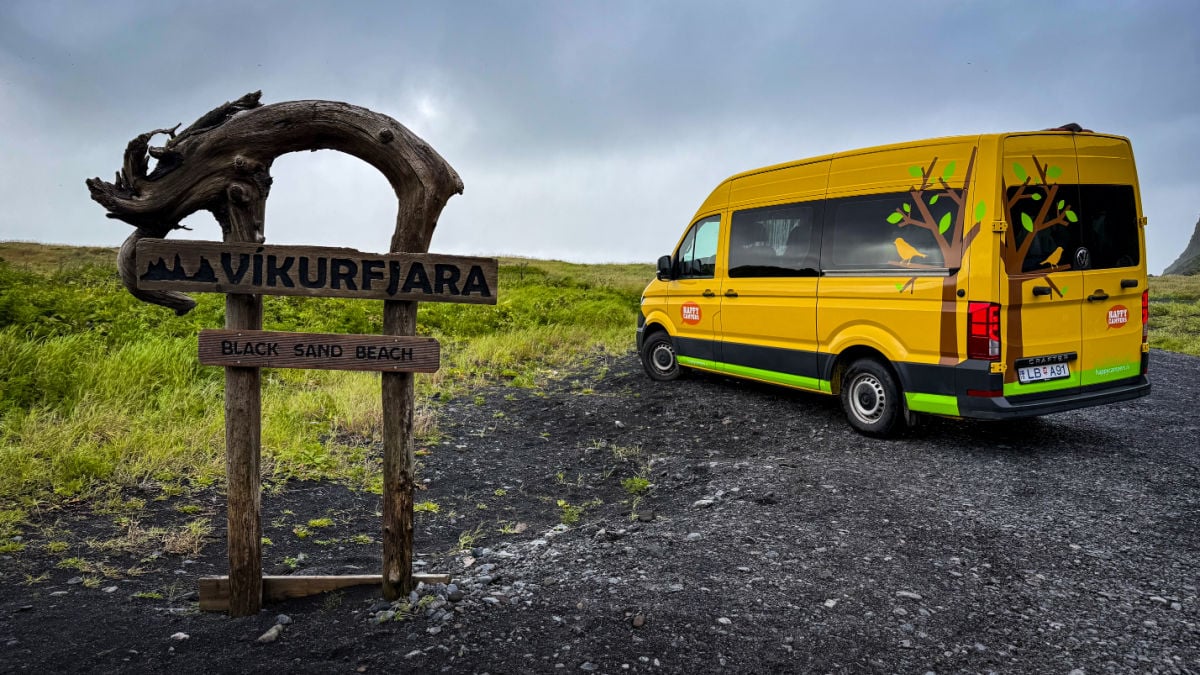
We had slept in more than we meant to, so we wrapped up at the campsite and took a quick drive over to a gorgeous beach, Vikurfjara.
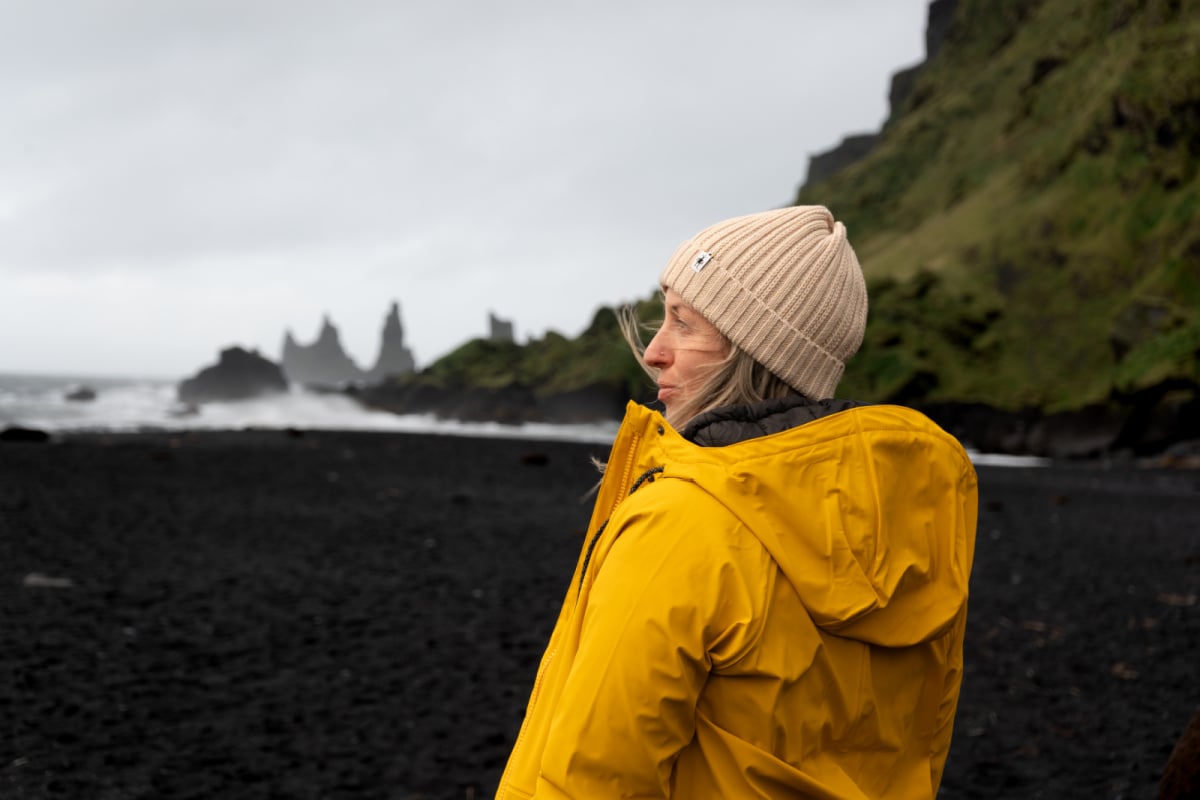
Sunrise at Vikurfjara Black Sand Beach delivered those moody sea-stack views—and a safety reminder: sneaker waves here are no joke.
Keep a wide buffer from the surf and heed closures.
We spent some time taking in the views, snapping pictures, and listening to the waves crash before heading back to the van to make breakfast. The perks of a home on wheels mean home-cooked meals anywhere!
After breakfast, it was time to hit the road towards a hike we couldn’t wait for, but we had a gorgeous surprise along the way!
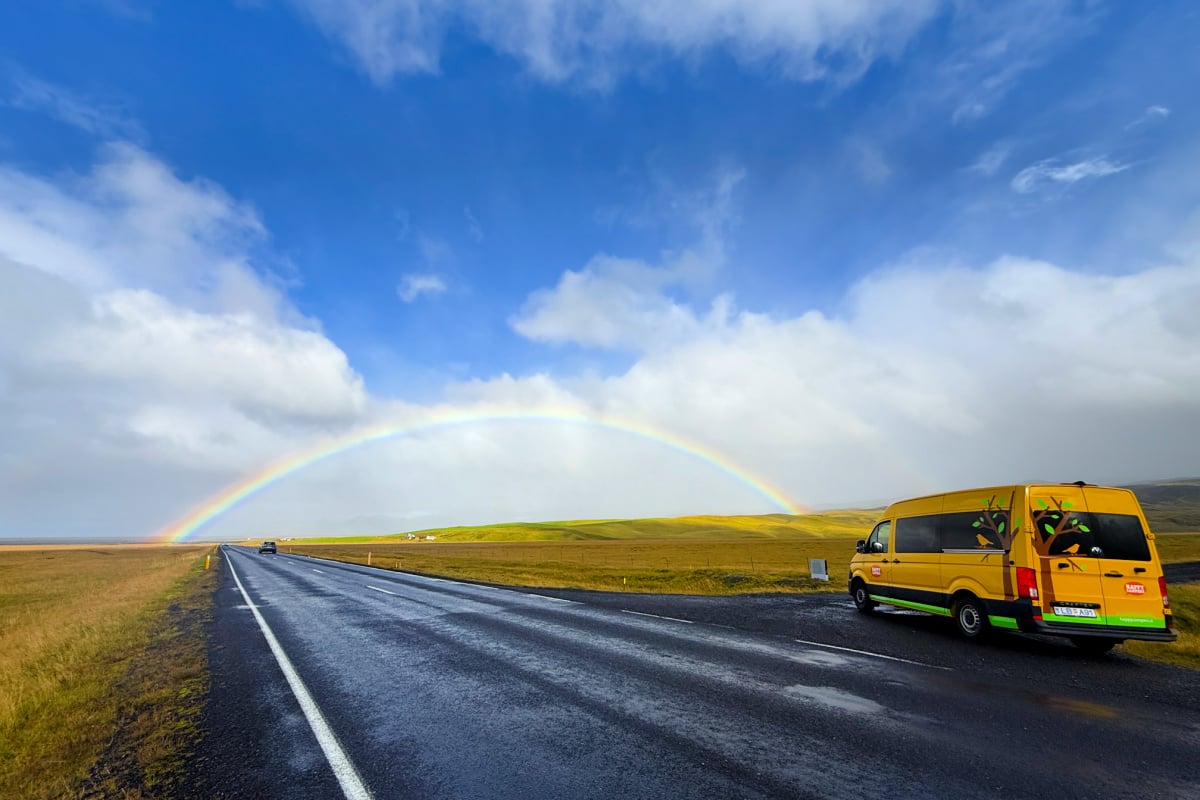
On our drive toward Hveragerði, Iceland flexed its weather magic: the brightest, fullest rainbow we’ve ever seen arced across the fields, so vivid that traffic literally pulled over to stare.
(With sunbursts and showers tag-teaming all day, rainbow sightings are common—keep your camera handy.)
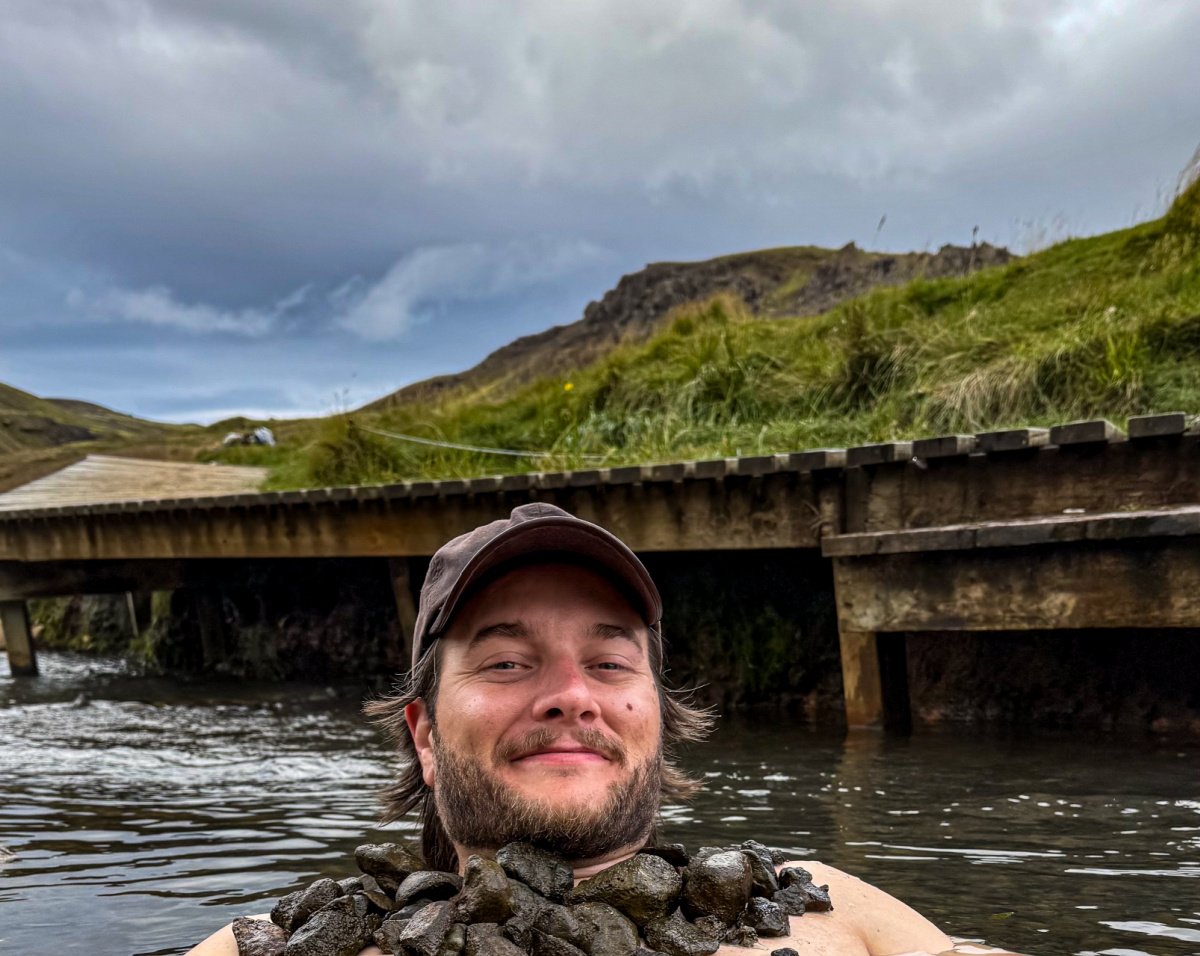
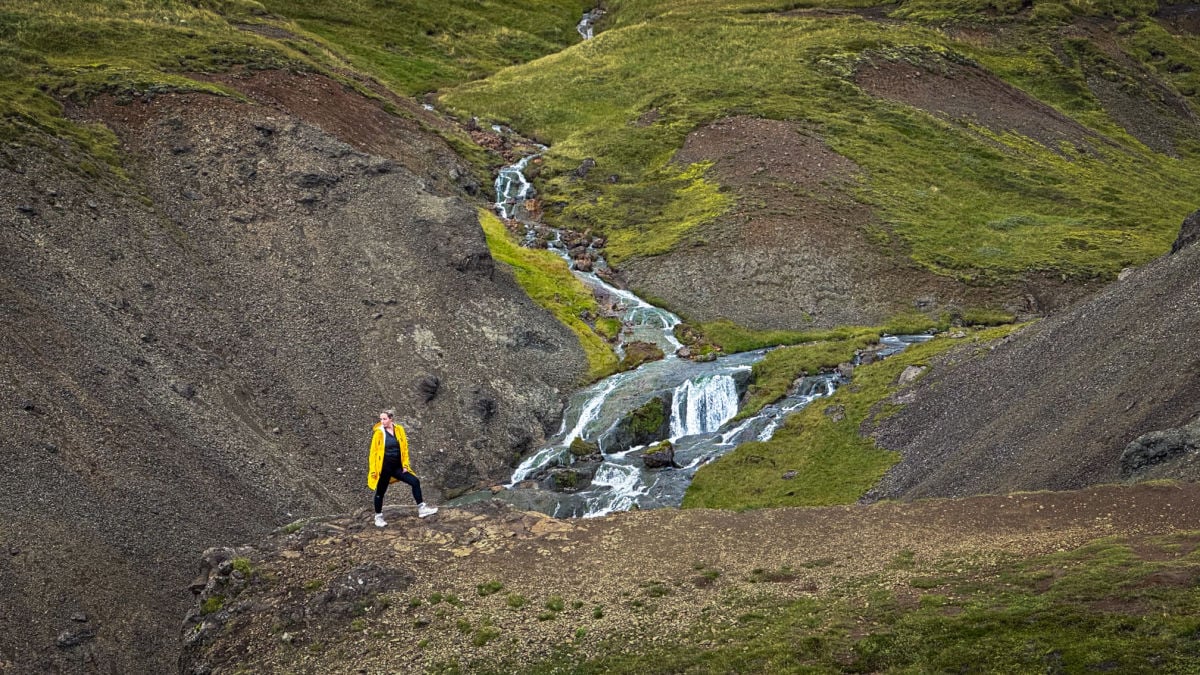
Then we hiked about an hour up to Reykjadalur Hot Spring Thermal River. We took our time and snapped photos along the way. There is a great photo op about halfway there of a pretty waterfall.
Be sure to bring water and maybe a snack if you are going to make an afternoon of it.
There’s a small paid parking lot at the base, and simple wooden privacy screens by the river—no enclosed changing rooms—so wear your swimsuit under layers if you don’t want to change in front of people (if you don’t care, nobody else does either).
We slid into hot-tub-warm water mid-river and stayed ~45 minutes, thawed to the core. It was a super relaxing experience and well worth the hike. The hike back down was just as pretty as the hike up, and our next stop was a National Park right near where the adventure all began.
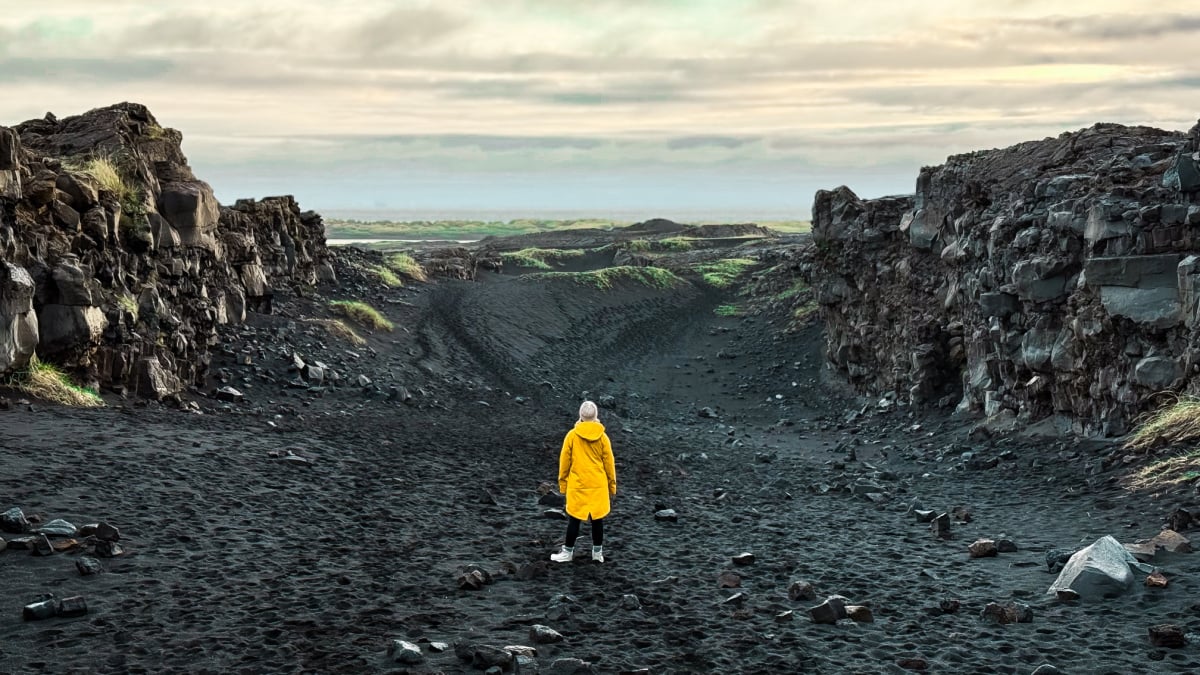
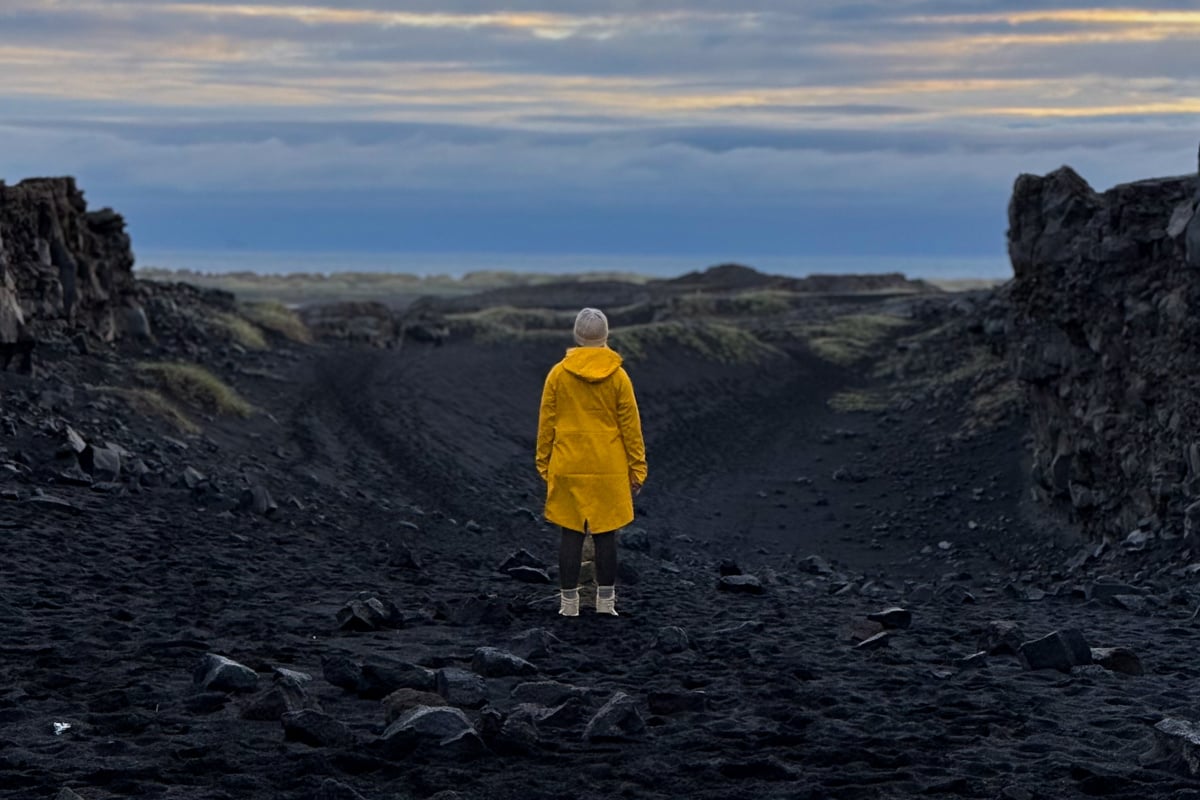
An afternoon at Þingvellir National Park capped it off—walking the rift where the North American and Eurasian plates pull apart is a geology-nerd dream and ridiculously photogenic.
Start at Hakið or stroll Almannagjá gorge for the classic “between continents” shot (the one right below).
This was sadly our last adventure in Iceland before heading off to Paris in the morning, but we made sure to enjoy our last night (even if we only slept 4 hours 😂).
We overnighted next to the Happy Campers base at their Happy Campsite Keflavik so we could roll 30 feet to drop off the van.
Their shuttle runs during business hours, so for a 6 a.m. flight we pre-booked a taxi; the 24/7 drop-off for the van made the return painless.
Why A Camper Van Makes 48 Hours Feel Bigger
Ultimate flexibility:Iceland’s weather flips fast; with a van we could change, snack, nap, or pivot plans instantly—like pulling over with everyone else to gape at that once-in-a-lifetime rainbow on Route 1.
All killer, no filler: Coffee after the Blue Lagoon, lunch at Seljalandsfoss, movie night during Vík rain, breakfast with sea stacks—zero time wasted.
Always connected: The in-van Wi-Fi hotspot kept maps, bookings, and work smooth the whole way.
Quick Logistics You’ll Want
Stopover 101:PLAY’s “Stayover” lets you pause in Icelandup to 10 days at no additional airfare; Icelandair’s Stopover offers up to 7 days at no additional airfare (flex fares can allow longer). Accommodation not included.
Blue Lagoon distance: Roughly 20 minutes from KEF and 50 minutes from Reykjavík; it’s easy to visit straight after landing.
Seljalandsfoss: Famous “walk-behind” waterfall right off Route 1; expect spray and slippery paths in poor weather.
Vikurfjara safety: Keep a wide margin from the waterline due to sneaker waves.
Vík Camping: 1 km from town center with showers, Wi-Fi, dining area, and laundry; popular with camper vans in season.
Happy Campers shuttle & hours: Free shuttle in the Keflavík area during business hours; for very early flights, taxi. Drop-off is 24/7.
How To Book The Free Stopover (2 Minutes)
Search your transatlantic route on PLAY or Icelandair. (PLAY is ending flights from the U.S. beginning October 24th, 2025).
Choose Stayover/Stopover and pick your Iceland dates (PLAY up to 10 days; Icelandair up to 7 days for most fares).
Complete the booking—there’s no extra airfare just for splitting the journey.
Final Take
In 48 hours we soaked at the Blue Lagoon, lunched at Seljalandsfoss, tucked into comfort food at Ströndin Pub Vík, camped in Vík, made breakfast on a black-sand beach, chased the wildest rainbow we’ve ever seen, floated in a mountainside hot-spring river, and walked between continents.
It was just a taste, and we’re already plotting two weeks in a Happy Camper to go deeper.
Iceland isn’t just beautiful—it’s built for adventure, even on a layover.
The Travel Off Path Advantage: Your Travel Toolkit
Subscribe To Our Latest Posts
Enter your email address to subscribe to Travel Off Path’s latest breaking travel news, straight to your inbox.
The Travel Off Path Advantage: Your Travel Toolkit
Subscribe To Our Latest Posts
Enter your email address to subscribe to Travel Off Path’s latest breaking travel news, straight to your inbox.
If you follow any travel blogs or read travel news, (and since you are here reading this, I will assume you do!) then you have undoubtedly read about Albania.
This small country located on the Balkan Peninsula in southeastern Europe has been gaining more and more attention recently for travelers looking for something different, affordable, and beautiful.
I spent five months at the start of 2021 living in Albania, and I am one of those people who won’t shut up about it.
Despite having been to many more countries since then, whenever people ask, “what country has been your favorite” or “what country left the greatest impression,” the answer is always Albania.
Here Are Some Things That Surprised Me The Most About Albania:
If you get to Berat, ask for Lili (you’re welcome)
Keep The Promise
The first thing that surprised me the most about Albania was the people.
The people you will find in this country are some of the nicest, most helpful, and most welcoming that I have ever encountered in all my years of traveling and living abroad.
You might have heard people refer to “Balkan Hospitality,” and this is absolutely a thing. Balkan people might seem a bit rough around the edges, but this is just a bit of a hard exterior that some of them have built up over the years.
I can’t tell you the number of times we have interacted with some gruff older men whom we were a bit intimidated to approach at first but ended up drinking rakia around a table with their family by the end of the conversation.
In Albania, there is a term: BESA, which means to keep the promise.
This is more of a way of life here, and the people will go out of their way to help you and make you feel welcome, allowing them to be trustworthy and keeping the promise of peace.
For example: One time we took a public bus to another city and upon reaching the destination, the driver realized we were unsure where to go. He didn’t speak any English and was shouting at us and demanding my phone, scary right?
Upon taking my phone he called our guesthouse and figured out where it was, and then proceeded to basically hold our hands and escort us there, making sure we were ok.
We were literally speechless at how out of his way he went to help us. This is the Balkan hospitality that I am talking about. Name another country where this would happen, I’ll wait.
A Not-So-Secret Secret
It’s funny because most people I speak to about Albania have never heard of it, and it seems the only ones who do know are other travelers and digital nomads.
While it used to be a bit of a secret, Albania has been growing in popularity for many reasons.
After going viral on TikTok recently, Albania is not such a top-secret destination anymore. Yet, when we arrived in Albania in January 2021, we were surprised to see so many other ex-pats living here already.
When doing our research, we assumed it was relatively unknown, but it ended up being the one country where we made so many friends quickly as there was a pretty well-established community of ex-pats and locals here. So, if Albania was a secret before social media, it wasn’t a very well-kept one.
Note: many of those we met were Americans, as we can stay a year visa-free.
An Albanian couple helped us get in here when we showed up just at closing, so nice!
From Budget To Bougie
Albania is an affordable destination, this is absolutely true, and most travelers who come already know this.
I came to Albania knowing this and was still surprised at how little you can spend here and live comfortably.
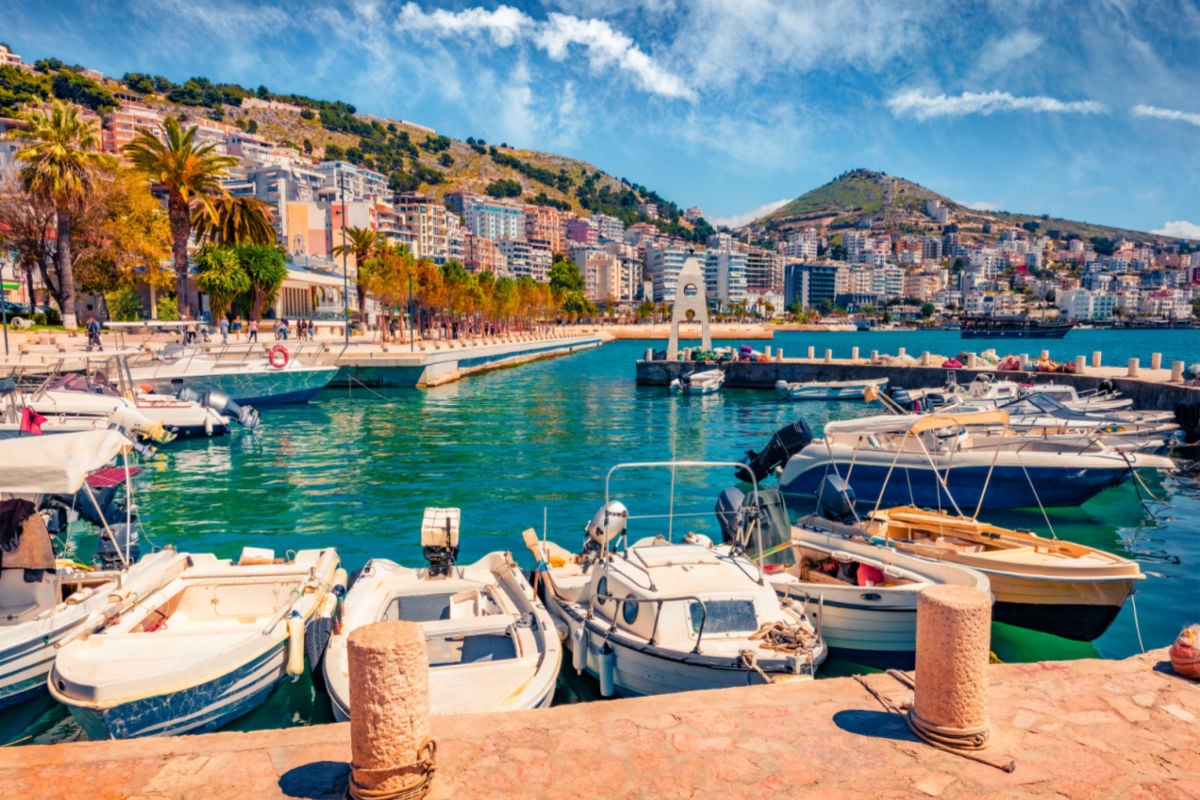
My apartment in Saranda cost under $500 a month and had sea views and a pool, not to mention high-speed wifi and smart TVs. I have friends who pay under $300 a month for their apartment because they made some good local connections, so it can be done.
You can get a beer for under a dollar at most places, and food (aside from imported items) is very cheap as well.
However, one thing to understand is that you can also splurge in Albania, and some accommodations and restaurants can run you Western prices and then some.
Pro-tip: become regulars at some of the beach bars in the early days of the opening season (springtime) and be treated to a free bowl of fresh mussels every time and everywhere you go!
Enjoying free mussels on the beach in Saranda
In the end, it’s all about how you want to live, but do keep in mind that the Albanian Riviera gets costly as the summer season approaches, so make sure to understand any rental agreements beforehand.
Many people I know had their rent doubled in the summer, so this is something to work out before signing anything.
Beach Please
Ok, let’s talk about the beaches. Most people who come to Albania in the warmer months do so in search of the Albanian Riviera, and for good reason.
Albania has the most beautiful beaches I have ever seen. The rocky shores make for crystal-clear water, and the sunsets are incredible.
Saranda has some decent smaller beaches around it you can enjoy, and of course, Ksamil is becoming more and more well-known as being as beautiful as the Caribbean.
One thing to realize, though, is that while not nearly as crowded as other popular European destinations, many of Albania’s beaches are far from a secret come summer.
While stunning, I was so surprised that these places get crowded quickly, and prices start to creep up.
If you are really looking for a quiet place to escape, head north and seek out some smaller beach towns along the coast. Ask any local, and they will probably insist you join them and their family on a trip (seriously).
Bunkers Bunkers Everywhere
Postcard Perfect Views
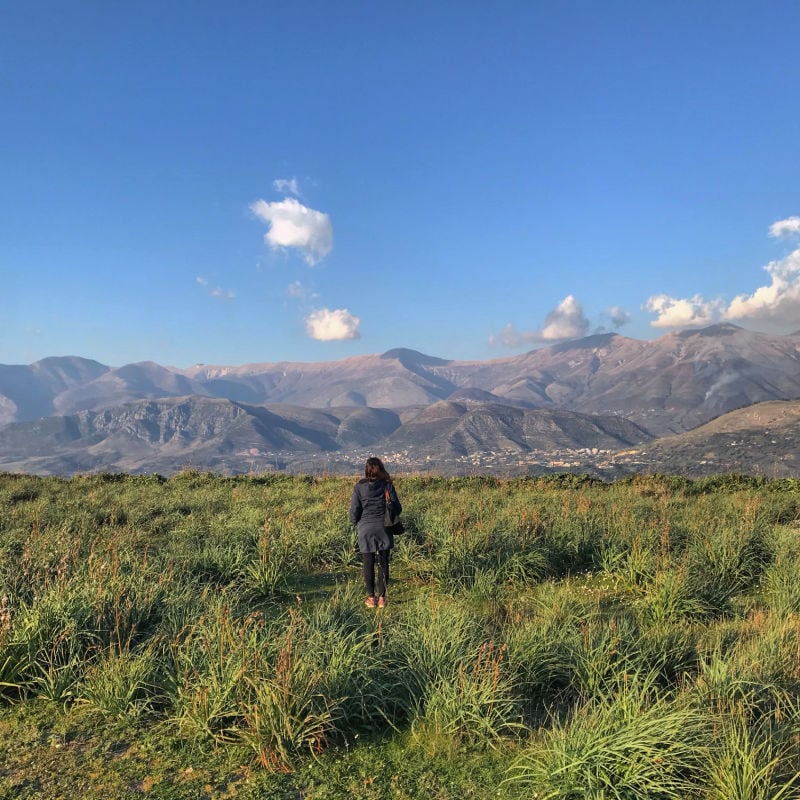
I was, and continue to be surprised at just how beautiful Albania is. Everywhere you look, there will be a turquoise coast crashing below the cliffs, or mountains and gorges, rivers, and everything in between.
One thing that I could not believe was the crystal clear green-blue of the Vjosa river that runs from Greece across Albania and into the Adriatic Sea.
This river is so beautiful and important, in fact, that it has just become the first Wild River National Park in Europe.
If you are lucky enough to call Albania home for a while, you will likely be surprised to see how easy most of the country is to explore via public busses and, of course, by renting a car.
Yes Means No And No Means Yes
While English is widely spoken in Albania, the official language is Albanian, referred to as Shqip. When speaking Shqip, one thing to pay attention to is how people indicate yes and no.
Yes is Po, and No is Jo. Not too difficult, right?
Now comes the tricky part, Albanians indicate yes with a shake of the head, meaning they are saying Po and shaking their head, which looks and sounds like No to a foreigner.
When they mean no, they nod their head up and down and say Jo. Still with me?
If you think it’s a bit confusing to read, imagine living it. You would think it would get easier, and it did, but even after months, there were still many situations where this interaction caused some confusion.
Luckily, Albanians are understanding and patient with foreigners, so it’s all good.
I hope my experience leads you to book that ticket, bus, or even the ferry from Corfu, Greece to explore Albania and all it has to offer.
Don’t tell me I didn’t warn you about the Rakia strength, though!
But seriously, if you are looking for an interesting and unique place to explore, with wonderful people and fascinating culture… the answer is always Albania.
I just spent a whole day exploring one of Europe’s poorest countries, where there are no shimmery Eiffel Towers, Mediterranean sunsets, or wide leafy boulevards lined with designer shops – and I almost couldn’t believe I was still in the same continent.
Comprising Southeastern Europe, the Balkan Peninsula is officially home to 12 nations, which all share a common culture and an intertwined History. It is also my go-to destination, home to gorgeous beaches and UNESCO-listed sites, the tastiest food, and beautiful, incredibly affordable citiesyet to be discovered, far away from the Instagram hordes.
Having been to Croatia, Albania, and Western Turkey, I decided it was time to go deeper into the heart of the region and explore what is perhaps its least-visited state:
Welcome To Kosovo, Europe’s Youngest Nation
Out of 12 countries that are either fully, or partially Balkan, the small, newly-independent Kosovo was the one nation I kept avoiding as I country-hopped across the peninsula. While I had the opportunity to visit twice since first arriving in the territory all the way back in 2019, both misinformation and misleading travel advisories always discouraged me.
Although it is certainly not fighting a full-fledged war, at least not anymore, Kosovo is yet to establish amicable relations with Serbia, from which it declared independence unilaterally in 2007. The latter has repeatedly refused to accept Kosovar sovereignty, and to this day, some maps include Kosovo as a Serbian autonomous province.
But why does Kosovo’s independence claim continue to be challenged by Serbia more than a decade later?
For most of the 20th century, these two countries formed the now-defunct federal entity of Yugoslavia alongside Croatia, Slovenia, Bosnia and Herzegovina, Montenegro, and North Macedonia. Beginning in the 90s, Yugoslavia began to crumble, and one after the other, the federal republics within it seceded, rejecting Serbian rule, though not without struggle.
Carrying the scars of the 90s war, responsible for re-shaping Balkan borders and establishing at least six new countries, and expressing a strong will to re-assert its Albanian identity, Kosovo was the last former Yugoslav territory to hold an independence vote only 15 years ago: Europe’s youngest (partially recognized) nation.
Regrettably, the Kosovar referendum was deemed illegal by Serbian lawmakers on the basis that Kosovo was never a constituent republic within Yugoslavia, unlike Croatia, Slovenia, or the others. Fast forward a decade, and the legal imbroglio continues to have repercussions, with Kosovo’s international recognition being limited and disputes extending well into 2023.
There are four main reasons why the people of Kosovo do not feel attached to Serbia and may want to untangle themselves from the persisting ghosts of the Yugoslav era:
Kosovo is inhabited by Albanians, who form the vast majority of the populace (92%)
Naturally, the most widely-spoken language in Kosovo is Albanian, an Indo-European language markedly different from Serbian
The most followed religion in Serbia is Eastern Orthodoxy (69.9%); Kosovo is 95.6% Muslim
For most of the 20th century, the Kosovar demand for more autonomy within Yugoslavia was largely overlooked and violently repressed by Serbian-controlled Yugoslav forces, giving rise to a strong anti-Serbian sentiment within the territory
Now that you know why Kosovo’s status is disputed, it is time we understood how actually underdeveloped it is as a nation standing on its own and why that came to be:
Kosovo Is The Third Poorest Country In Europe
Due to its complex recent past, assuming that it is independent from Serbia, Kosovo has been named the third-poorest country in Europe, with almost 30% of the population, or 550,000 Kosovars, falling below the poverty line. In 2016, it had an unemployment rate of 34.8%, and a majority of families earned less than €6,000 per year.
In addition to a low Human Development Index, Kosovars struggle from:
Not being members of the European Union and having their movement in Europe severely restricted
Not being a part of NATO, which puts them at an increased risk of attacks by neighboring belligerent countries
Having the weakest passport in Europe; as of 2022, Kosovo passport holders need visas to enter most European countries, and they are only granted visa-free access to 41 countries worldwide
Refused admission in countries that do not recognize Kosovar independence and thus Kosovar-issued travel documents (Georgia, Moldova, Cuba, and others)
Kosovo, and the wider Balkan Peninsula, are indisputably European, being an integral part of the continent’s multicultural, multi-ethnic, and multi-faith character. However, they are a different flavor of Europe, lying outside the Brussels sphere of control and occasionally resembling Western Asia in terms of urban planning, culture, and infrastructure.
For the most part, there are no wide, tree-lined Belle epoque boulevards to be found here. Instead, you should expect streets crammed with overhead power cables and overflowing garbage in the style of Latin America’s run-down hoods. Additionally, Kosovo isn’t the ideal destination for tourists looking for the quintessential European sightseeing experience:
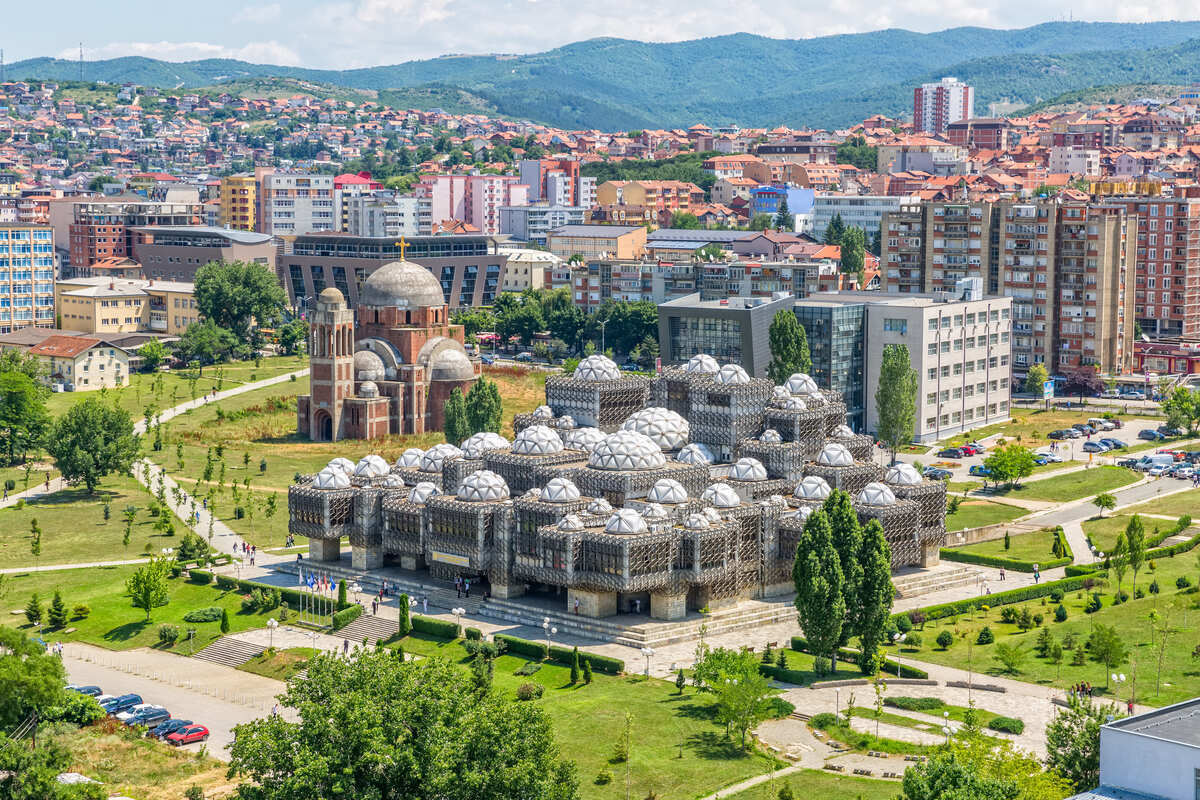
Several historical buildings in Pristina have either been destroyed or heavily damaged by bombing, and what’s left are a handful of medieval mosques and Serbian Orthodox Churches, modernist apartment blocks evocative of the communist years, and war memorials paying homage to the Kosovar Albanians who lost their lives fighting for autonomy.
So why, then, is Kosovo worth visiting?
Six Reasons Why Kosovo Should Be On Your Radar For 2023
Incredibly Welcoming Locals
The hospitality of Albanians precedes them, and upon arriving in Pristina, my first destination on this day tour, I was reminded why they have a reputation for being one of the most friendly people in Europe. Whether you’re shopping for souvenirs or simply asking for directions, you will feel their warmth and be greeted by genuine smiles.
From the few interactions with Kosovars I had during my excursion, I felt as if they were as elated as they were puzzled I was traveling there in the first place. Locals will go out of their way to make sure you feel welcome, be it eagerly sharing their customs and traditions, or pausing whatever it is they’re doing to help a tourist in need of assistance, without expecting anything in return.
We must remind ourselves this is a newborn country hosting less than 200,000 foreign tourists on average per year, and ensuring tourists have a good impression is in their best interest.
It Is Home To Beautiful Historical Sites
Kosovo may have been ravaged by war, and it’s true several of its historical monuments are either undergoing reconstruction or were razed to the ground, giving way to modernist buildings that wouldn’t be totally out of place in the bygone Soviet Union, but this does not mean there’s no architectural beauty to be found here, or an inestimable cultural value at that.
The Balkans are perhaps the most History-charged region in all of Europe, and Kosovo is no exception. One of the main points of interest in the country is the beautiful 14th-century Serbian Orthodox Gracanicka Monastery. Embellished by vibrant frescoes and atmospheric candles, it is one of a handful of UNESCO World Heritage Sites in Kosovo.
Yet another example of Orthodox architecture that’s been enlisted by UNESCO is the Patriarchal Monastery of Pec, located near the city of Peja, famous for its striking red exterior. Elsewhere in Kosovo, visitors can also admire the remnants of well-preserved 18th and 19th-century Ottoman houses.
Wandering the cobblestone streets of Prizren to the bewitching chants emanating from the nearby minarets, you will be transported back to the Anatolian heartland of Turkiye. Distinctly oriental in character, Prizren features an old Ottoman bridge arching over a clear river and imposing mosques glistening white against the surrounding green hills.
Some call it the prettiest city in Kosovo, and one of the prettiest in Southeastern Europe.
It must be something in the water… In recent years, Kosovo has been spawning an impressive streak of pop stars that are crossing over to the mainstream and making it big in America. Two of the most easily recognized artists whose families hail originally from here are the multi-platinum British artists Dua Lipa and Rita Ora.
Dua is, in fact, one of the most successful female artists of the streaming era with several top ten hits under her belt – with Don’t Start Now, Levitating, New Rules, and Physical to name a few – and other successful collaborations with world-renowned DJs and industry veterans like Elton John. Other than advancing the Kosovar cause, she’s been credited for ‘putting Kosovo’s name on the map‘ and reviving the country’s dying cultural scene.
Now, visitors to Pristina can attend an annual international music festival held in summer organized by Sunny Hill Foundation, headed by Dua Lipa herself and her father, Kosovo-born businessman Dukagjin Lipa. While she’s on tour, the singer is usually included in the line-up, which features other international acts and local Albanian artists.
Out of all 37 European countries I have set foot in, Kosovo has to be the one where my tourist dollars stretched the furthest. Even if you’re ready to splurge after being locked down at home for nearly three years, and you’re ordering every possible appetizer on the menu, getting a bill of more than 20 euros per person at a mid-range restaurant will be virtually impossible.
Additionally, entry to cultural attractions is, on average, €2 to €5 (such as the Gracanicka Monastery), making it incredibly affordable to explore over a few days or even a longer period of time. On average, the cost of living in Kosovo is 61.68% lower than in the United States, with monthly expenses without rent estimated at €359, or roughly $382.
An important piece of info: Kosovo has no official currency of its own, and they have adopted the euro unilaterally. It is by far the most widely accepted currency in the country, though it may be possible to find businesses that accept or exchange U.S. dollars, British pounds, or other popular currencies.
It’s Every Foodie’s Idea Of Paradise
Albanian food ranks among my favorite in Europe, mainly because it resembles other ethnic dishes concocted by the Turkish or the Greek, with ingredients that are always fresh, melt-in-your-mouth meat rolls, soup rich in spices and unique Balkan condiments, and a wide assortment of locally-sourced fruit and salted, soft cheeses.
Whether you’re in Kosovo, Albania, or any other Albanian-majority region of North Macedonia or Greece, rest assured you will be well looked after by your Albanian hosts. Some of my favorite picks are:
Fergese, a flavorful paste made mainly of tomato sauce, cottage cheese, green peppers, and garlic, served traditionally with bread
Byrek (the Albanian equivalent to the pan-Balkan burek), a flaky dough pastry filled with potatoes, spinach, meat, or cheese
Tarator, a cold soup containing sour yogurt, shredded cucumber, a few squeezes of lemon, and several teaspoons of salt
Speca te mbushura, rice-stuffed green peppers. In some Albanian regions, chopped lamb and/or tomatoes can be added
Qofte, meatballs that can be grilled, fried, or baked
Tave kosi, lamb baked in a melting pot of homemade yogurt, rice and eggs
Kosovo Is A Unique Country To Explore
Having traveled Albania extensively, I had the impression it borrows heavily from Italian and Greek cultures, resting cozily in its Southern European, Adriatic nook. To all effects, the Republic of Albania effortlessly fits all the Mediterranean criteria: pristine beaches, freshly caught seafood, Greco-Roman monuments, and laid-back vibes throughout.
Kosovo, on the other hand, is landlocked, and not only its cuisine but the locals’ way of life as a whole is entirely defined by its geographical features. You will not find an abundance of seafood here, though the traditional meat-heavy shqiptarë diet remains a defining trait, as does Albanian folklore and ethnic attire.
At the same time, it has incorporated other Turkish and Slavic influences, having spent centuries under Ottoman rule, and later in a state union with the South Slavic communities. The constant redrawing of the borders and influx of immigration from neighboring countries has given rise to a unique Kosovar identity that is closely related to Albania’s, but not exclusively Albanian.
This small, overlooked territory is, in essence, the Balkan Peninsula and all of its contrasting identities in a nutshell.
How To Get To Kosovo In 2023
Notably, there are no direct flights from the United States or Canada. Reaching Pristina from the Americas, U.S. travelers must change flights at least once. When it comes to one-stop connections, options are limitless: most of Europe’s major transit hubs, such as London Heathrow, Vienna, and Frankfurt, have established year-round air links to Kosovo.
Geographically, the closest country Americans can fly into is, ironically, Serbia. Belgrade is served by direct Air Serbia flights leaving from New York (JFK), with one-way fares starting at $618 this winter. Landing in Serbia, Kosovo-bound travelers are required to travel via land to the disputed territory (which Serbia continues to claim as its own).
Alternatively, international buses to Pristina depart from Skopje, in North Macedonia, and Tirana, Albania, as well as other select cities in the Balkans. Timetables may change depending on the date of the week, and tickets are normally purchased from the ticket office at bus stations. Fares range between $25 and $30 for return trips, though they can be more expensive depending on the transportation provider.
If you’re planning on taking the bus from Belgrade, the journey is usually hassle-free for those entering Kosovo after crossing into Serbia first. Americans who first cross into Kosovo, either via Pristina Airport or any other border crossing points with North Macedonia or Albania, and continue traveling onward to Serbia, will be barred.
The Problem With Entering Serbia After Crossing Into Kosovo First
As Belgrade considers Kosovo an integral part of its territory, border authorities have ruled that all non-Serbian nationals entering from the latter without a valid Serbian stamp on their passports will have crossed into Serbia illegally. Americans attempting to do should expect to be turned away at the border unceremoniously.
In sum:
Traveling from Serbia into Kosovo with Serbia as the initial entry point: perfectly legal in Serbia’s view (the same applies to re-entering Serbia after visiting Kosovo)
Traveling from Kosovo into Serbia without an initial Serbian entry stamp on your passport: illegal on Serbia’s part
Unless you are planning on visiting Serbia after Kosovo, you should not worry about these border disputes and complex technicalities. However, if you’re backpacking across the Balkans, and you would prefer not to get on the wrong side of a Serbian immigration officer, you must ensure you are stamped by them first.
To the best of my knowledge, previous visits to Kosovo that did not involve an accompanying visit to the northern neighbor should not pose an impediment for entry into Serbia in the future, unless you’re unlucky enough to run into hostile border staff, who may take their time questioning you over a fading stamp.
Want To Avoid All These Confusing Border Rules? Consider Booking A Private Tour Of Kosovo Instead
As I booked a private day tour of Kosovo leaving from Skopje, the capital of North Macedonia, located a short one hour and a half away, I entered via a land crossing point. The experience was rather smooth, and my incredible guide, Smile, from Skopje Daily Tours, handled all border formalities so I could worry about appreciating the scenery instead.
I am not an enthusiast of guided tours myself, particularly those involving a group. Personally, I prefer exploring new destinations at my own pace, and usually with enough time to have a couple of days at leisure. Unfortunately, this time round, I would be flying out of the Balkans on the very next day, and being so short on time, booking this private visit was the right call:
It is considerably more expensive than an excursion, but you have more freedom to personalize your itinerary and get to know your driver/guide a little better
Guides working for Skopje Daily Tours are Historians, or Geopolitics experts with extensive knowledge of Kosovo – and you’re free to ask them any questions you may have about the Balkan conflict
Traveling by car with an authorized guide, there is less waiting at land borders – buses are normally checked thoroughly to ensure there are no smugglers and that they meet certain standards until they are allowed to cross
No stops at the usual tourist traps or overpriced souvenir shops: your guide will ensure time is optimized and that you have the best possible experience, eating in reasonably-priced restaurants and seeing truly relevant sites
Prices for a private day tour of Pristina and Prizren, two of Kosovo’s main cities, start at €55.
Safety
Reading travel advisories on Kosovo, I’d be surprised if anyone decided to visit at all. In general, Western countries make notes on the unsolved Serbo-Albanian quarrel, warning their citizens of higher crime levels, ‘high tensions’ along the border with Serbia, and the threat of terrorism and violent demonstrations.
Kosovo is indeed a country with deep-rooted issues that is yet to fully achieve peace and normalize relations with its Slavic neighbor, but visiting the main tourist zones, namely the cities of Pristina and Prizren, phone in hand and speaking English unashamedly, I felt as safe here as anywhere else (in the Balkans).
Walking in Pristina, my limited knowledge of Albanian was my only concern being approached by friendly, smiling natives at local cafes or shops, who seemed as delighted to be running into a foreign guest as I was for visiting. One must bear in mind Kosovo is definitely not one of these European hotspots suffering from overtourism – on the contrary.
With that being said, I refrained from touring North Mitrovica, Leposavic, Zubin Potok, and Zvecan, where confrontations between Albanians and Kosovo’s ethnically Serbian residents have been known to erupt with little warning and restricted my movements to Pristina’s city center and the Old Town in Prizren, popular sightseeing areas.
On top of that, I was accompanied by an experienced guide who ensured I would not deviate from the touristic path and put myself in harm’s way. Unless you are directly involved with paramilitary groups or extremist organizations, and you’re not actively looking for trouble (e.g. wandering heavily patrolled borders), trouble will not come to find you.
Rules For Entering Kosovo In 2023
Kosovo has removed all of its Covid entry requirements since May 2022.
Vaccination is no longer a prerequisite for entry
There is no testing regime in place prior to, upon, or after arriving
Travelers are not expected to stay in isolation for a period of time after arriving
There are no online forms or pre-flight registrations to be made flying to Kosovo
Bottomline
This tiny, newly-independent state, plagued by ethnic conflicts and that’s yet to fully recover from a bloody war, is finally finding its footing as an off-path tourism hub. Although it is quite a way-off from other more developed neighbors, it has a lot of unexplored potential to charm tourists who usually flock to Western Europe.
Yes, it has somewhat of a reputation for being a little rough around the edges, but Kosovo is a beautiful place to explore… If you know where to look.
We just spent a weekend in what’s arguably the most liberal and ‘free’ city in the Middle East, and the things we found and saw there were far more surprising – and dare we say, exciting – than we were expecting.
Writing for Travel Off Path, I like to think of myself as a lover of freedom and advocate for an open world. After all, we have been covering the different levels of restrictions imposed on citizens over the course of the last two years and strongly supporting the resumption of normal tourism. As a traveler myself, I tend to favor destinations where individual liberties are upheld.
Not only when it comes to freedom of movement, but where people are not persecuted or criminalized based on their gender, sexuality, or political views, and that is safe in general for outsiders who don’t speak the language and/or are unfamiliar with the local customs.
Health crisis aside, I mostly avoided the Middle East in my years of traveling, not because it didn’t appeal to me – Iraq, for instance, is one of my bucket list destinations – but because it has developed a reputation for being a hotbed of religious quagmires and strict laws governing social life… Right?
As it turns out, that’s not always true, especially when it comes to this one compact metropolitan gem tucked away on the Eastern shores of the Mediterranean:
Not The Middle East I Expected
I’ll take a guess here, and please, do let me know if I’m wrong in the comment section. When you think ‘Israel’, the first image that pops to mind is probably that of ancient cities carved out of limestone, where both History and religion walk hand in hand, and the droves of pilgrims flock into every corner looking for some sort of religious awakening.
Am I wrong? Well, that’s not too far from the truth, as Israel is, indeed, the Land of the Bible, as well as home to places held as holy in all three major religions – Judaism, Islam, and Christianity. We all know it can be an incredible destination for believers, irrespective of the Abrahamic branch they belong to, but what about others?
Others like me, who are thrill-seeking young digital nomads who do not feel strongly about any particular religion and who wouldn’t necessarily mind the occasional infusion of History, but are simply hoping to have a cracking time for once. Luckily for both demographics, Israel has the best of both worlds: sites of huge historical importance and unparalleled city breaks.
Of course, it is the birthplace of Jesus, John the Baptist, King Herod, and all other Bible icons that have long been in our social imagery, whether we were born into a Christian household or simply hail from the Christianized Western World. But then again, it is home to Tel Aviv, which is the most overlooked city I’ve ever set foot in… and perhaps one of the most vibrant.
What Makes Tel Aviv Great?
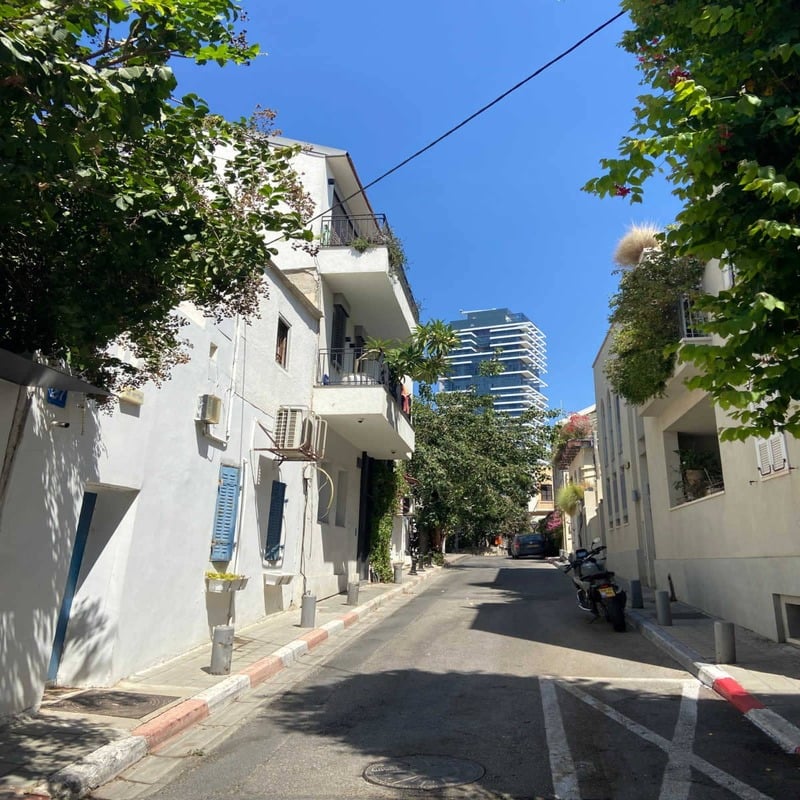
In a country as packed with millennia-old monuments and wild nature as Israel is, Tel Aviv is a city that looks almost out of place. Its monumental skyscrapers cannot be found anywhere else, and the unblemished white of its signature Bauhaus architecture looks strikingly alien in a country where the ocher-tinged tone of its historical buildings is the commanding color.
Tel Aviv is an aberration, and although some of the Orthodox Jews of Israel would certainly like to keep it in line with the more-conservative Jerusalem and Nazareth, I mean it as a compliment of the highest order. This is the Land of Creation’s younger, rebellious child, who owes its charming looks to a century of innovation and openness to the outside world.
It couldn’t have been any different: it was established on the shores of Israel’s central Mediterranean Coast in the early 20th century, and throughout the decades that followed, it hosted an influx of migration from the Americas, Europe, and other Middle Eastern neighbors, as far southwest as the continent of Africa.
This amalgamation of cultures, customs, languages, and ethnicity is still very much present in Tel Aviv. It is indisputably a city belonging to the Jewish State at its core, but if you’re looking for Israel’s equivalent to a multi-faith international community and/or more permissive branches of Judaism, then here is where you’ll find them.
Being a gay man holding what I would like to consider a ‘progressive’ worldview, I felt at ease in Tel Aviv as I would normally in Amsterdam, Stockholm, or Lisbon. Granted, I can’t speak for other groups, and certainly not for women, but even then, I was under the impression tourists from all walks of life would feel just as embraced and welcome as I was.
In fact, finding the odd rainbow flag proudly displayed on a private balcony or a shop’s front door isn’t a strange sight in Tel Aviv. In the wider Middle East, where numerous countries still criminalize same-sex relationships or even expect women to live under certain constraints, this is certainly a testament to its status as a young, free city.
Top Things To Do In A Weekend In Tel Aviv
Tel Aviv may look imposing in pictures when it excels at mimicking New York City’s skyscraper-dotted skyline, but in reality, it is a small town with big city aspirations. By that, I mean it is incredibly compact, in spite of its metropolitan feel, and getting from one end to the other will not take you longer than 35-40 minutes of driving (if there’s traffic).
This is why it is such a perfect weekend getaway: most of the attractions are all clumped together and can be seen in a single day. Below, I have listed six of my favorite things to do while on a weekend in Tel Aviv:
6. Swim At One Of The City’s Beaches
You’re free to be yourself in Israel.
Many Americans may not be entirely aware of this, but Israel straddles Western Asia’s Mediterranean shore. In other words, the world’s most sought-after beach destination, where Ibiza, Santorini, Cyprus, and the like are located, incorporates Israel on an extent – and like any Mediterranean hub, Tel Aviv’s access to the sea makes it a popular swimming hotspot.
I’m not even one for beach hopping myself, but I certainly couldn’t resist relaxing at a Hilton Beach lounge on a scorching mid-September afternoon, fresh-squeezed lemonade and Kindle at hand, hearing the sound of waves crashing and the faint hint of pop music coming from the nearest beach bar. Absolute heaven.
It is also known for being the ‘gay beach’ of Tel Aviv, though judging by its diverse crowd of young bathers, it is popular among all groups. However, if you’re coming with your family and would prefer a more child-friendly spot, I can suggest Gorden Beach instead, located directly opposite the Sheraton Hotel, or even Geula Beach.
5. Go For A Bite To Eat At Carmel Market
Around 50 – 66 NIS (≈ $14 – $19 USD) for a one-course meal
I’m not the biggest fan of street markets myself. I have little use for the trinkets and souvenirs shouting vendors try to sell you at any cost, nor do I particularly enjoy being hurried along amid the current of tourists and other curious onlookers exercising their bargaining skills. For that reason, I wasn’t truly looking forward to visiting the open-air Carmel Market.
It was, however, part of my Tel Aviv Weekend Tour itinerary, and as soon as we approached the first row of shops stacked with Persian rugs, art pieces looking meticulously made, and the smell of kebab grilling on skewers, I knew I was in for a treat, and couldn’t have been more grateful to my guide, Michael Skir, for insisting we came here.
Carmel Market couldn’t be farther from your usual tourist trap, with all its colorful flowers – irises, gladiolas, and roses that owe their blood-red vibrancy to a prosperous Mediterranean climate – dried fruits, dates, and other Western Asia classics, as well as a plethora of unique condiments I would have loved to take home myself, were I not a dreadful cook.
Moreover, it is one of the best lunch spots in all of Tel Aviv: its corridors are home to various restaurants and street food stalls, and I certainly felt spoiled for choice in picking a favorite. If your heart is set on traditional Middle Eastern cuisine – especially if you’re hoping to sample some humus – then this is the place to be.
Perhaps the farthest out of the six – that is, if you’re staying central – Tel Aviv University’s ANU Museum was bound to become one of my highlights for a very simple reason: my favorite pastime is cuddling up to my cat, burying my nose in a book, and spending hours on end ruffling through the pages, lost in thought.
A museum chronicling the trajectory of Israel as one of Ben Gurion’s most ambitious projects, and then a nation over time, ANU felt very much like a giant-sized book full of textures and vibrant imagery I could just walk into. Similarly to the Museum of Contemporary History in Bonn, Germany, still my all-time favorite, each floor of ANU is dedicated to a particular period of Jewish History.
Slowly working your way down from the top floor, you will learn how ethnically diverse and surprisingly multicultural the Jewish peoples are, what has been their collective angst and goal across centuries, who are some of the brightest minds to have been born in Israel, and how far this relatively new country has come in as little as seven decades.
My only regret? Not having planned longer than an hour here.
3. Downtown Is Where It’s At
Catch the vibes.
Tel Aviv may not be the ideal destination for those fixated on deep cultural expeditions, but it does shine through with its extensive list of world-renowned restaurants, some of which I will detail further down, bohemian districts where youngsters pour into the streets for a much-needed weekend relief, and a cafe culture rivaling that of Europe.
The best place to feel the atmosphere and mingle with locals and visitors alike is the Downtown Area, close to the iconic Rothschild Avenue and any of the smaller streets feeding into it, such as Allenby, Florentin, and Levontin. Here, you will find alfresco dining options, quirky themed cafes waiting to go viral on TikTok, the country’s top-rated nightclubs, and even co-working spaces perfect for digital nomads.
Being completely unaware of Tel Aviv’s hidden wonders until I landed, I could have easily skipped the 20th-century city altogether and headed straight to the nearest Roman-era citadel. Sky-high apartment blocks, busy city life, and shopping centers are not exactly my cuppa, but now, I’m so glad that I didn’t.
It’s precisely this eccentricity and the city’s unique status as a modernized financial center in the heart of the primeval nation, whose existence has been enshrined on the pages of the world’s best-selling book, that make it worthwhile, even if only for a long weekend.
2. The White City
You’ll want to take your time here.
Besides being home to Israel’s liveliest social scene, Tel Aviv is a guidebook for minimalist aesthetics. An experimental ground for Bauhaus, a 1919 creation of German architect Walter Gropius, Tel Aviv’s historical center is home to a vast collection of whitewashed, UNESCO-listed monuments comprising the so-called ‘White City’.
Strolling the area, tourists are graced with views of rectangular-like or round structures without intricate decorations or the ornate, romantic forms you’ll find in Europe’s Belle epoque buildings. Tel Aviv’s oldest neighborhood, which defies other contemporary developments, is both a lesson in architectural practicality and a sight to behold.
These geometric shapes are spread across the city center, and they’re surely not hard to find, but for some of the most iconic sights, I strongly suggest you visit Rothschild Boulevard, Tel Aviv”s pulsating vena cava, adorned with some of Gropius’ finest feats, and Dizengoff Square, the setting for a futuristic water fountain display flanked by Bauhaus landmarks.
1. The Ancient Jaffa
Tel Aviv’s equivalent to an Old Town.
My favorite district in all of Tel Aviv, Jaffa is an ancient port dating back thousands of years that was slowly absorbed by the city as it grew larger, rising from a mere 34,000 inhabitants in 1920 to over 400,000 today. Luckily, its strong identity as a distinct entity hasn’t entirely vanished, in spite of the contrasting 21st-century skyline surrounding it.
As soon as you cross the former municipality’s symbolic threshold, which proudly reads ‘Welcome to Old Jaffa’, you will feel like stepping back in time and into an alternate reality where Tel Aviv’s modern sea promenade and a cluster of skyscrapers give way to narrow alleyways, lined with little craft shops, museums, and centuries-old churches.
Doubtless, Jaffa is the most Instagrammable district in Tel Aviv, and in short walking distance of the White City, it makes for an incredible day trip away from all the hustle and bustle. Once in Jaffa, make sure you check out:
Jaffa Port
Ilana Goor Museum
The Flea Market
The ‘Suspended Orange Tree’
The Frank Meisler Gallery
The Great Mahmoudiya Mosque
St Peter’s Church
The House of Simon the Tanner
Tel Aviv Should Be Every Foodie’s Dream Destination
Out of the 40 countries I have visited so far, and more than 200 cities globally, I must confess Tel Aviv would rank somewhere in my top 5 for foodie destinations. Whether it’s sizzling shoarmas straight from the market, or fine dining overlooking the Mediterranean coast, travelers are for sure in for a treat, irrespective of budget.
My tour group, headed by Michael Skir Tours enjoying a Mediterranean-style dinner in the famous Manta Ray Restaurant
Compiling the list below was a tough pick, but I did try my very best:
Puaa, a mid-range cafe and restaurant located in the heart of Old Jaffa’s flea market, is known for its variety of hummus, cheese, and Mediterranean dishes (I cannot recommend their Balkan-style moussaka highly enough);
ARIA, features a downstairs bar and lounge and a cozy upstairs restaurant with views of Downtown Tel Aviv. Their Arab-style mains are beautiful, especially the Persian kebab with fresh vegetables and tahini;
Manta Ray is a beach-side restaurant known the world over for its comprehensive seafood menu and the assortment of Meze that accompany it, ranging from Mediterranean salads to Balkan bread and everything in between.
As a devoted foodie myself, and an enthusiast of off-path travel, I couldn’t help but verge off the main route and explore a side of Tel Aviv most tourists are completely unaware exists. Luckily, my guide Michael knew just where to go to quench my thirst for authentic experiences, and thanks to him, I met one of Israel’s most renowned cooks, Myassar Seri.
Mrs. Seri is an Israeli citizen of Palestinian origin who leads cooking workshops from her own home, nestled in Jaffa, and who has done an awe-inspiring job at bridging gaps between Israelis, regardless of their religion or political inclinations, and sharing her culture with other men and women who are willing to learn it.
Amid the ongoing Arab-Israeli conflict, witnessing this woman’s willingness to heal old wounds, and express her own family history through a rich, flavorful Arab cuisine that’s been passed along generations upon generations, is an experience I will cherish forever, and one I can only encourage other visitors to undertake.
As you’ve been made aware already, I may be a terrible cook myself, and I am sure I wasn’t of much help in my group, but in spite of my clumsiness and ceaseless efforts to spoil the tahini – one of my main tasks that day – it still turned out to be one of tastiest entrées I’ve had in my life.
Either I’m not nearly as bad in the kitchen as I thought I was, or Mrs. Seri’s miracle-working hands somehow saved the day.
I’m banking on the latter.
It Was A Movie…
Cinema Hotel, Zamenhoff St 1
If you’re flying all the way from America to Israel and you’re planning on spending a weekend in Tel Aviv, like me, I would first advise you to steer clear of shady AirBnB owners and stay in the White City area, a prime location for short-term visitors, within walking distance to all the major shopping centers, street markets and the Port of Jaffa.
I will go even further and personally recommend Esther Cinema, my own hotel. A true Bauhaus jewel towering over Dizengoff Square, one of the main landmarks I mentioned earlier, this hotel has a life of its own. Not only was it once one of Tel Aviv’s first cinemas, it boasts incredible views of the White City below and a sumptuous breakfast spread.
Today, other than the vintage film posters hanging from the walls and the enviable display of movie projectors dating back to the 1950s, there is little left of Esther Cinema on site to indicate that this hotel, part of Atlas’ Boutique portfolio, was ever designed to welcome passionate moviegoers, but you will still find:
It is remarkably stylish, with an interior that pays homage to the decayed magic of Hollywood
Breakfast is included, with a wide array of salads, pastries, and even hot dishes that kept me full until the early evenings
The hotel hosts a happy hour with complimentary refreshments, other tidbits, and live music
Amid the current hotel fare surge in other beach destinations, Cinema Hotel’s are still relatively affordable*
*The price for a Twin Room is an estimated USD 188.00 per night on Booking.com
How To Get To Tel Aviv
Direct flights to Ben Gurion International, Israel’s main entry hub serving both Tel Aviv and Jerusalem, are available from:
Boston (EL AL Israel Airlines)
Chicago O’Hare (United Airlines)
Las Vegas (EL AL Israel Airlines)
Miami (American Airlines + EL AL Israel Airlines)
New York-JFK (American Airlines + EL AL Israel Airlines)
New York-Newark (EL AL Israel Airlines + United Airlines)
San Francisco (EL AL Israel Airlines + United Airlines)
Washington-Dulles (United Airlines)
I’d advise you to check airfares with each airline for more competitive prices – as we have seen this year, they might have been hiked as a result of the soaring inflation. On the bright side, those looking for a last-minute deal for their fall vacays will be thrilled to learn this off-season has been the best time to book international flights globally.
Can I Travel To Israel If I’m Unvaccinated?
Earlier this year, Israel removed all health entry requirements for foreign visitors, including U.S. citizens arriving from the United States. Heading into the fall, all of the following apply:
No vaccination certificates are required, including boosters
No pre-departure testing, even for the unvaccinated
No post-arrival testing
No post-arrival quarantine at a government-listed facility
No mandatory masks in any public settings
Despite the relaxation of measures, tourists must still complete a Passenger Locator Form up to 48 hours prior to departure.
So yes, Tel Aviv – and, to an extent, the astoundingly beautiful country of Israel – is open for tourism and looking forward to having you back. For unique experiences and a customized itinerary based on your own profile as a traveler, get in touch with the knowledgeable Michael Skir, who was my own contact on the ground while in Israel.
Without Mr. Skir’s expertise, insightful comments,and love for Israel, it would have been much more challenging to peel off all these layers of Tel Aviv I didn’t even know existed.
Enter your email address to subscribe to Travel Off Path’s latest breaking travel news, straight to your inbox
Disclaimer: Current travel rules and restrictions can change without notice. The decision to travel is ultimately your responsibility. Contact your consulate and/or local authorities to confirm your nationality’s entry and/or any changes to travel requirements before traveling. Travel Off Path does not endorse traveling against government advisories